


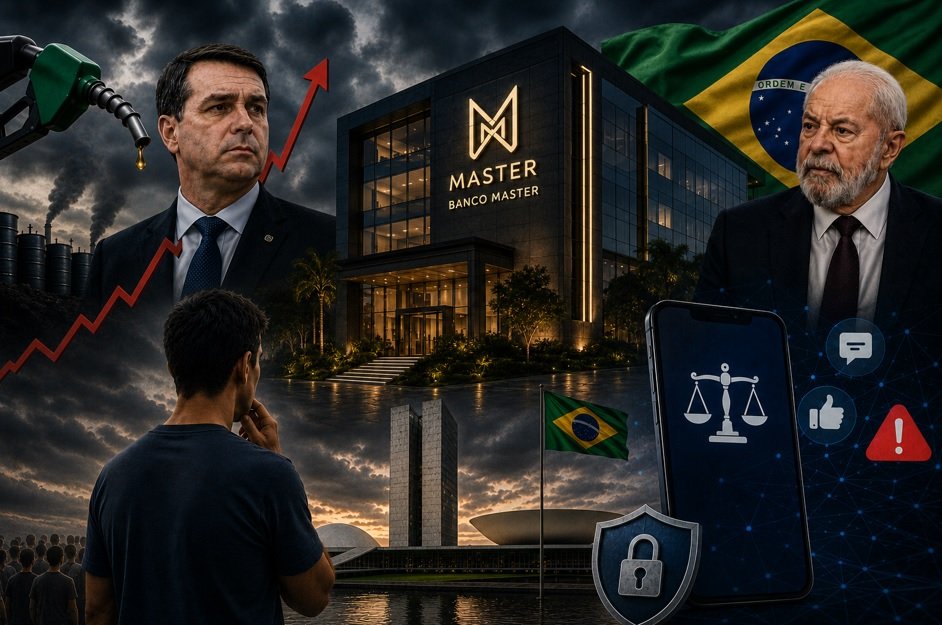
Brazil’s political and economic landscape is facing a turbulent moment as the country navigates multiple converging crises. Inflation expectations have surpassed the Central Bank’s target ceiling for the first time this year, driven in part by global fuel price pressures linked to the Iran conflict. On the political front, presidential pre-candidate Senator Flávio Bolsonaro finds himself embroiled in a growing scandal over his ties to banker Daniel Vorcaro, raising doubts about the viability of his candidacy among his own party’s leadership. Meanwhile, President Lula’s government continues to struggle with predominantly negative approval ratings, despite a slight recent uptick in public opinion. Against this backdrop, undecided voters — a critical electoral bloc — remain skeptical of both sides, and the government has moved to tighten regulation of social media platforms through new decrees updating Brazil’s internet governance framework.
This Content Is Only For Subscribers
To unlock this content, subscribe to INTERLIRA Reports.
Inflation
Economists consulted by the Central Bank of Brazil raised their inflation forecast for 2026 above 5% for the first time this year, reflecting growing pessimism over the effects of the conflict involving Iran and rising global fuel prices. According to the Focus bulletin released on Monday (25), analysts now expect the IPCA, Brazil’s official inflation index, to end 2026 at 5.04%, an increase of 0.12 percentage points compared to the previous week’s forecast. The projection exceeds the ceiling of the inflation target established by the Central Bank, which is set at 3% with a tolerance margin of 1.5 percentage points above or below the target.
Visit
Presidential pre-candidate and Senator Flávio Bolsonaro (PL) visited Daniel Vorcaro, owner of Banco Master, after the former banker’s first arrest at the end of 2025. The revelation exposed a new chapter in the relationship between the two, days after the disclosure of an audio recording in which the senator asked Vorcaro for money to finance the film “Dark Horse,” about former president Jair Bolsonaro (PL). The meeting took place at Vorcaro’s residence in São Paulo after he was released from prison on November 28 by a decision of the TRF-1 (Regional Federal Court of the 1st Region), which imposed restrictions such as the use of an electronic ankle monitor. The new revelation shook the party’s benches in Congress and reinforced concerns among allies that another scandal could bury the senator’s candidacy. Members of the PL leadership believe that the next 10 to 15 days will be decisive in assessing whether Flávio Bolsonaro can remain a viable candidate and whether the accusations will have electoral consequences.
Evaluation of the Lula Government
The government of President Lula (PT) received slightly better evaluations according to a new Datafolha survey released on May 22. Despite the improvement, the president’s approval ratings remain predominantly negative. The government is considered bad or terrible by 38% of respondents, while 32% rate it as excellent or good. Another 28% classify the administration as average. The survey was conducted on May 20 and 21 with 2,004 respondents in 139 municipalities. Compared to the previous poll, released on May 16, positive evaluations increased by two percentage points, while negative assessments fell by one point. The new survey was also the first to measure the political impact of revelations published by The Intercept Brasil involving Senator Flávio Bolsonaro and Daniel Vorcaro.
Undecided
Amid the political crisis caused by the revelation of the relationship between Senator Flávio Bolsonaro (PL), a presidential pre-candidate, and Daniel Vorcaro, owner of Banco Master, undecided voters reportedly viewed the senator’s explanations with skepticism. Considered decisive for the outcome of this year’s election, this segment of the electorate has also expressed dissatisfaction with measures announced by the Lula government, including the “Desenrola 2.0” debt renegotiation program, which some describe as electoral in nature. Representatives of this group — especially undecided voters and residents of strategic electoral regions — have been monitored closely by both the left and the right whenever major political developments occur. Since July last year, they have reacted to issues such as the tariff increase imposed by the United States on Brazilian products, the government’s response to the crisis, debates surrounding the PEC da Blindagem, the proposed amnesty for those convicted over the January 8 attacks, and the search for a political successor to Jair Bolsonaro following his imprisonment for attempted coup d’état.
Big Techs
President Lula (PT) signed two decrees on Wednesday (20/05) creating new rules for the operation of social networks and big tech companies in Brazil. One of the decrees updates the regulation of the Marco Civil da Internet after the Supreme Federal Court (STF) changed its understanding last year regarding the liability of digital platforms. Under the new interpretation, platforms may be held responsible in some cases even without a court order requiring content removal. The second decree establishes measures aimed at protecting women from violence on the internet. According to government representatives, the initiative was motivated by the increase in online scams and attacks targeting women and girls on digital platforms.
Analysis:
Brazil is entering a particularly delicate phase in which economic pressures and political instability are reinforcing one another ahead of the presidential election cycle. The rise in inflation expectations above the Central Bank’s target ceiling reflects growing concerns about Brazil’s vulnerability to international shocks, especially the effects of geopolitical tensions involving Iran on fuel and energy prices. This scenario creates additional challenges for the Lula administration because inflation directly affects consumer confidence, household income, and the cost of living, areas that traditionally have a strong impact on political approval. Even though the government has registered a modest recovery in public opinion, the predominance of negative evaluations demonstrates that dissatisfaction remains deeply rooted.
At the same time, the controversy involving Senator Flávio Bolsonaro and banker Daniel Vorcaro introduces new uncertainty into the opposition field. The revelations surrounding financial requests connected to the production of a film about Jair Bolsonaro have generated discomfort within the Liberal Party itself and exposed the fragility of a candidacy heavily dependent on political credibility and association with anti-establishment discourse.
Sources: O Globo [1], [2], [3], [4]; G1 [1], [2]; A Folha de SP [1], [2].

