


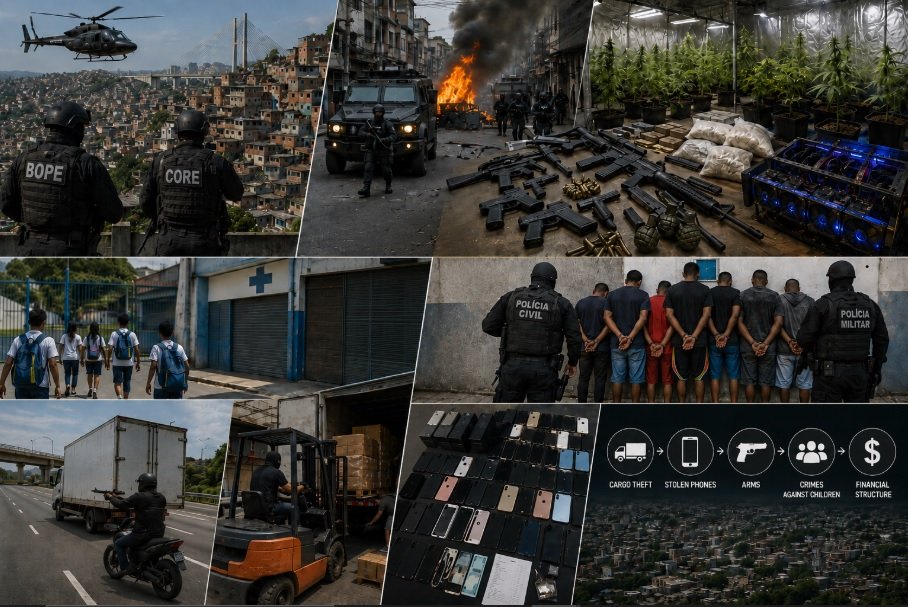
Civil and Military Police forces launched Operation Trinus on Wednesday morning (10/06) against drug trafficking activities in the Maré Complex, located in Rio de Janeiro’s North Zone. The operation involved six simultaneous enforcement actions targeting a range of criminal activities, including drug trafficking, cargo theft, homicide, robbery, and child sexual exploitation. Authorities sought to execute 56 arrest warrants and 42 search-and-seizure warrants against members of the Third Pure Command (TCP) criminal faction. Upon entering the communities, officers came under gunfire, while criminals set fire to barricades in an attempt to hinder police movements. As a precautionary measure, schools and health clinics in the area suspended activities during the operation.
This Content Is Only For Subscribers
To unlock this content, subscribe to INTERLIRA Reports.
The Operation Structure
The offensive personnel involved from the Special Operations Battalion (BOPE) and the Special Resources Coordination (CORE), the elite units of Rio de Janeiro’s security forces. During the operation, officers seized firearms, including rifles and grenades, and dismantled two marijuana cultivation sites as well as a cocaine processing laboratory. Investigators also discovered a cryptocurrency mining operation, commonly known as a mining “farm,” operating within the community.
Disney Ball
One of the principal targets of the investigation is the “Disney Ball,” identified by investigators as a key component of the faction’s financial structure. According to the police, the event works as a channel for the circulation of stolen goods, fundraising activities, and the strengthening of the criminal organization’s influence and image within the communities under its control.
Six Fronts
Operation Trinus is the result of months of investigative work conducted by the 21st Police Precinct (Bonsucesso), with support from intelligence units. Authorities divided the investigation into six separate fronts, uncovering what they describe as a criminal structure extending far beyond drug trafficking. According to investigators, the organization was involved in cargo theft, the resale of stolen cell phones, attempted homicide, domestic violence offenses, illegal possession of firearms, and crimes related to the sexual exploitation of children and adolescents.
Cargo Theft
The main focus of the operation centers on a cargo theft scheme that investigators believe became firmly established within Maré in recent years. According to the Civil Police, armed TCP traffickers intercepted trucks traveling along major transportation corridors such as Avenida Brasil, Linha Vermelha, and Linha Amarela. Using motorcycles and support vehicles, the criminals surrounded drivers, threatened them, and forced them into communities controlled by the faction. Once inside the area, the stolen cargo was transferred to other vehicles. In some cases, investigators found evidence that forklifts were used during the unloading process, demonstrating a significant degree of logistical organization. Authorities further allege that the stolen merchandise was integrated into a broader commercial network, with local businesses being used to store, receive, and distribute the goods, creating an economic chain linked to the criminal group.
Numbers on the Increase in Robberies
Data gathered during the investigation illustrates the scale of criminal activity within the jurisdiction of the 21st Police Precinct. Between January 2020 and June 2026, authorities recorded 1,350 cargo robberies in the area. The highest number occurred in 2024, with 302 incidents. In 2025, that figure fell to 194, representing a 35.7% reduction, a trend police attribute in part to ongoing investigative efforts. Vehicle thefts also remained a significant challenge. Between 2020 and June 2026, the precinct registered 4,328 stolen vehicles. The peak was likewise recorded in 2024, with 1,148 cases. In 2025, the number dropped to 574 incidents.
Stolen Cell Phones Had a Price List
Another aspect of the operation focuses on an organized network dedicated to cell phone theft and the resale of stolen devices. According to investigators, criminals received firearms and motorcycles from the faction to carry out robberies and were required to meet targets established by gang leaders. Victims were often forced to unlock their devices during the robbery itself, increasing their value on the illegal market. Testimonies collected by police indicate that an unlocked smartphone could be sold for as much as R$2,500, while locked devices were typically sold for between R$300 and R$600.
Analysis:
Operation Trinus illustrates how organized crime in Rio de Janeiro has evolved far beyond traditional drug trafficking. The investigation suggests that the TCP has developed a diversified criminal economy capable of generating revenue through multiple illicit markets, including cargo theft, stolen electronics, arms possession, and other offenses. This diversification reduces dependence on drug sales and makes criminal organizations more resilient to law enforcement pressure. The discovery of structured logistics, including the use of forklifts for unloading stolen cargo and organized distribution networks within the community, indicates a level of operational sophistication more commonly associated with criminal enterprises than with conventional street gangs.
The cargo theft scheme described by investigators demonstrates how strategic geography can be transformed into a criminal advantage. The Maré Complex is located near some of Rio de Janeiro’s most important transportation corridors, allowing criminals to quickly intercept commercial vehicles and move them into areas where state presence is limited and access is difficult for security forces.

