


Summary
Cell phone theft in São Paulo is not simply declining—it is transforming, with an overall reduction in cases and a shift in where crimes are concentrated. While the expanded central region—traditionally the main hotspot—has seen consistent declines due to intensified policing and targeted interventions, other areas, particularly in the South Zone periphery, have experienced a rise in incidents.
At the same time, crime has become more selective and organized. High-end devices such as iPhones are increasingly targeted, and specific methods, such as the “glass-breaking gang,” have become more frequent. In parallel, investigations reveal that these thefts are part of a broader criminal structure that connects street-level robberies to financial fraud and international trafficking networks.
This Content Is Only For Subscribers
To unlock this content, subscribe to INTERLIRA Reports.
Crime Patterns
Cell phone theft in São Paulo remains heavily tied to the dynamics of its central region, even as 2025 data from Mapa do Crime, based on figures from the São Paulo Public Security Secretariat (SSP), show a clear geographic shift in where crimes are concentrated. Historically, the main hotspot due to intense pedestrian flow, commerce, and transport hubs, the expanded center played a decisive role in the city’s overall improvement: total thefts dropped 15.5%, from 59,974 cases in 2024 to 50,692 in 2025.
This decline was driven largely by significant reductions in central districts. In Consolação, incidents fell 32% (from 912 thefts in 2024 to 619 in 2025), while Campos Elíseos saw a 23.7% decrease. During the same period, avenida Paulista, once the leading location for iPhone thefts, recorded a 56% drop in cases involving Apple devices (from 197 to 86 thefts), falling to seventh position in the in the ranking of most targeted neighborhoods. These results are closely linked to intensified policing strategies, including increased patrols and coordinated operations in high-traffic areas.
Despite this decline, the center remains a structural reference point for understanding the crime: its high circulation and commercial importance create conditions for opportunistic theft, even amid declining numbers. The reduction in central areas also helps explain the citywide trend, particularly the slight decrease in iPhone thefts overall (down 1.8%, from 21,703 to 21,320 thefts).
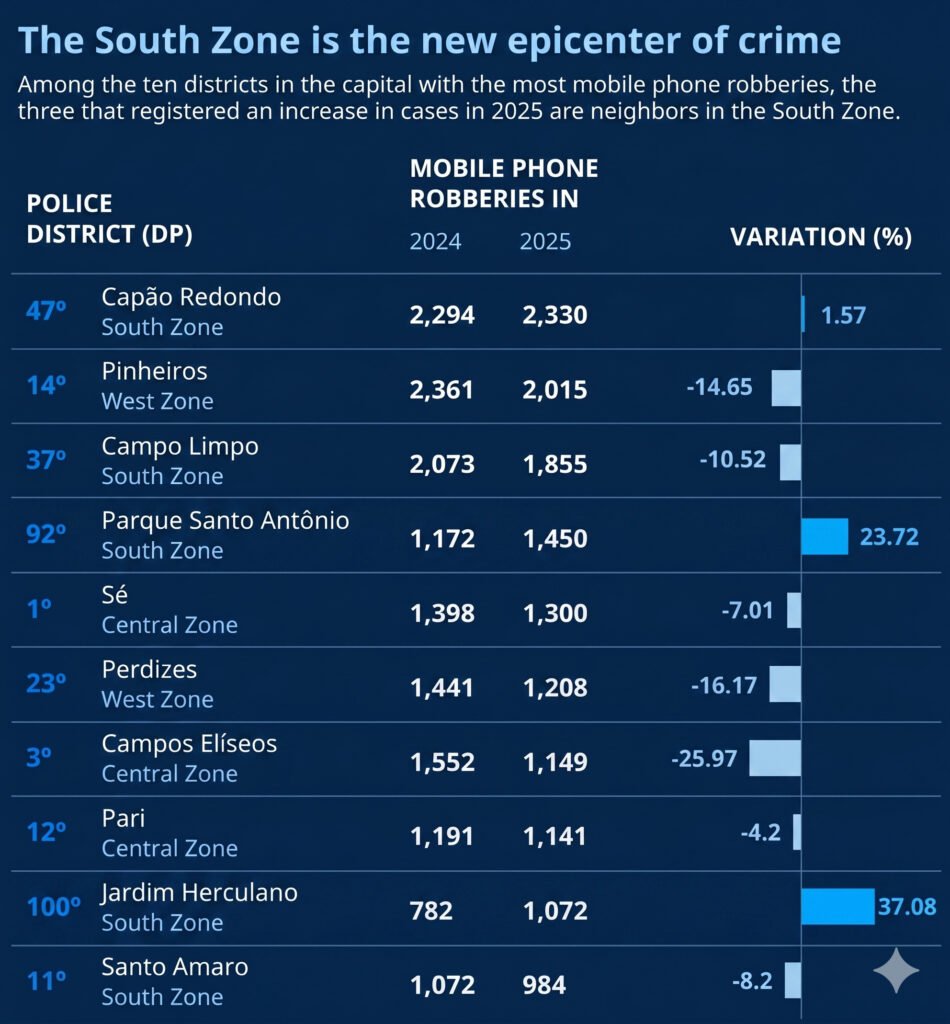
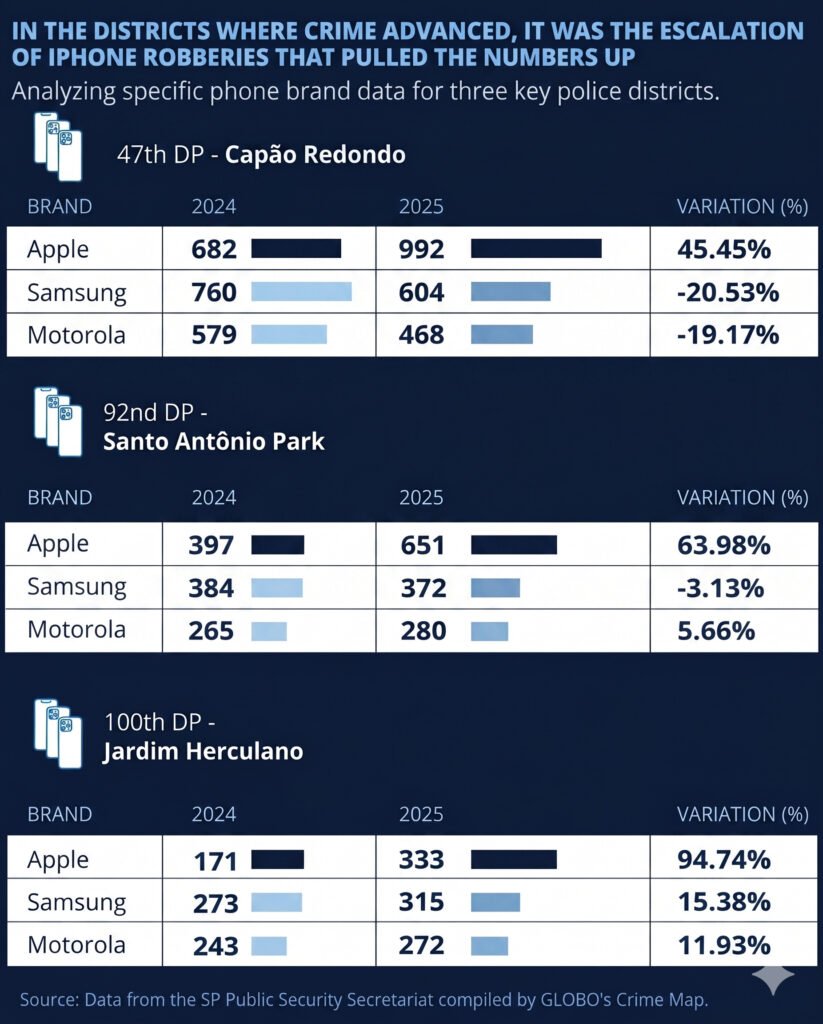
Outside central areas, the trend moves in the opposite direction. Districts such as Capão Redondo, Jardim Herculano, and Parque Santo Antônio experienced a surge in thefts, totaling 4,852 cases in 2025—an increase of 14% compared to the previous year. Notably, these areas were among the few in the top ten neighborhoods with the most crime to record growth, driven largely by a sharp rise in iPhone-related crimes.
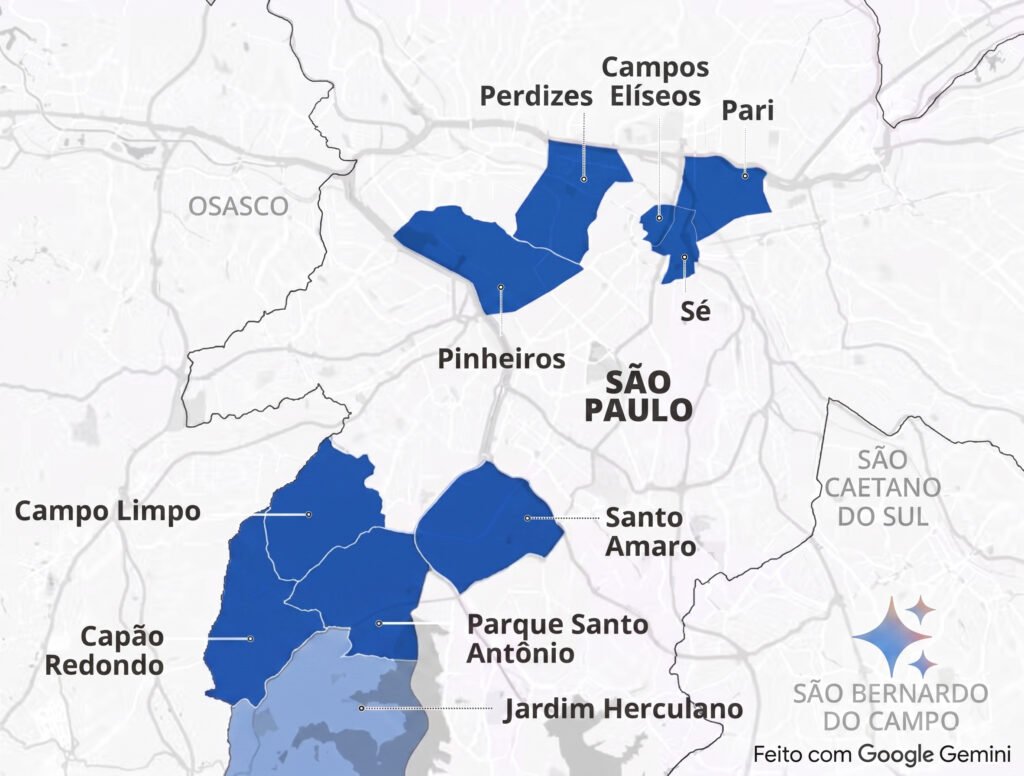
This contrast suggests that crime has not been reduced overall but redistributed across the city. While targeted security policies have proven effective in the central region, the expansion of theft into peripheral areas reveals how criminal networks adjust to enforcement pressure and reinforces the need for citywide strategies. This shift is also reflected in the growing selectivity of crime, particularly in the targeting of these devices.
iPhone Targeting
In São Paulo, cell phone theft shows a clear pattern of selectivity, with Apple devices as the primary target. According to data from Mapa do Crime, iPhones accounted for 21,320 thefts in 2025, an average of 58 incidents per day. This concentration indicates that offenders prioritize devices with higher resale value and broader use in secondary markets.
The distribution of cases is not uniform across the city. A small number of major transit corridors and high-circulation areas concentrate a significant share of incidents. Avenida do Estado leads with 162 cases, followed by Rua Augusta (148) and Rua da Consolação (125), all of which connect central areas with zones of intense economic and social activity. Other relevant locations include Avenida Presidente Castelo Branco (111), a key exit route from the city, and Rua Mourato Coelho (88), situated between busy nightlife districts.
Police precinct data reinforces this spatial concentration while also indicating geographic spread. The 14th Precinct (Pinheiros) records the highest number of incidents, with 1,413 reports, followed by the 47th (Capão Redondo) and 37th (Campo Limpo), both in the South Zone. Additional concentrations appear in the 23rd Precinct (Perdizes) and the 92nd (Parque Santo Antônio).
Together, these patterns suggest that cell phone theft in the city follows a defined logic: it combines high-value targets, strategic locations linked to mobility and circulation, and a distribution that extends beyond central into peripheral areas. This selectivity also helps explain the rise of specific methods designed to target these devices.
Glass-Breaking Gang
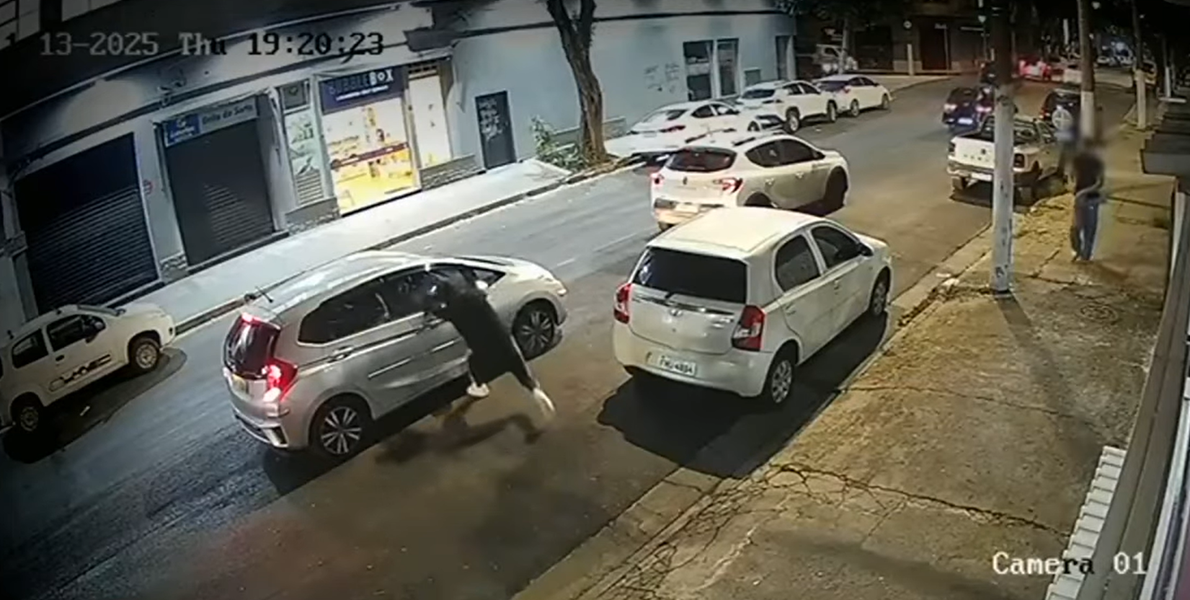
TV presenter and chef Erick Jacquin said on Instagram he was the victim of a robbery by the glass-breaking gang on April 6 in São Paulo. Jacquin was inside a taxi when criminals approached the vehicle while stuck in traffic, smashed the window, and stole his cell phone within seconds. Although the device did not contain banking applications, he warned friends and acquaintances not to transfer any money, as the attackers had access to his unlocked phone. He also advised the public to avoid using cell phones in the back seat of cars, especially in congested areas, where drivers and passengers are more exposed.
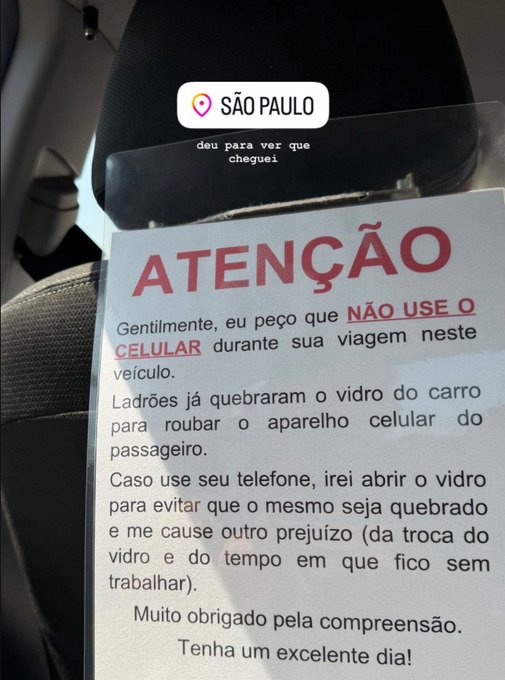
This case reflects the growing presence of the “glass-breaking gang,” a criminal pattern that has spread across São Paulo, particularly along major roads and across the expanded downtown area. The method is direct and highly efficient: assailants identify victims using their phones while vehicles are stopped in traffic, approach on foot, and break the car window using rocks, tools, or blunt objects. The theft itself takes only a few seconds, leaving little time for any reaction. In many cases, the attackers immediately flee on foot, blending into the urban environment or escaping through nearby streets and alleys.
Drivers and passengers frequently describe the experience as shocking and violent. Many report that the sound of the glass shattering resembles a gunshot inside the car, followed by fragments scattering across the interior, causing physical injuries. Many residents report a constant sense of fear in these areas, avoiding even basic actions such as checking their phones in traffic. In areas such as Rua do Glicério, witnesses say these robberies occur throughout the day—morning, afternoon, night, and even at dawn—indicating a high level of frequency and organization.
The expansion of this method has also altered the geography and timing of these crimes in the city. While locations such as Avenida Paulista were previously central hotspots, routes like Avenida do Estado—characterized by intense traffic and long congestion periods—have become key targets, recording 279 incidents in 2025. The glass-breaking method is especially prevalent on heavily congested routes such as Marginal Pinheiros, Marginal Tietê, Avenida 23 de Maio, and several streets in the central region. Criminals take advantage of predictable traffic patterns, targeting moments when vehicles are fully stopped, particularly during peak commuting hours between 6 PM and 9 PM, when traffic jams create ideal conditions for the attacks.
The crime has also affected other public figures, reinforcing its widespread nature. Actress Luisa Arraes shared on social media that she experienced what she described as a “classic” robbery, in which her car window was broken and her phone taken. Musician Lucas Lima reported an even more violent incident, suffering cuts to his neck, arms, and hands when criminals shattered his car window while he was on his way to the airport.
In response to the escalation of these crimes, authorities have launched targeted operations to dismantle these groups and reduce incidents. In March, São Paulo’s Military Police arrested 70 individuals as part of actions focused on glass-breaking robberies and related criminal activities, including drug trafficking. Police presence has been reinforced in critical areas, with increased patrols and monitoring in locations identified as recurring hotspots. What happens after these thefts is key to understanding the scale of the problem.
Resale Network
Unlike most Brazilian capitals, where cell phone theft is largely driven by the local resale of stolen devices and parts, São Paulo presents a multi-layered criminal system. Investigations conducted by the Civil Police and the Public Prosecutor’s Office indicate that the market for stolen phones in the city extends beyond informal trade, supplying dismantling operations, street markets, and organized groups involved in financial fraud, logistics, and international resale. For guidance on how to reduce potential losses after a theft, see this article.
A significant portion of the devices stolen in São Paulo—especially those taken through the “glass-breaking” method—are directed to criminal networks specializing in banking fraud. These groups often request phones that are already unlocked, allowing immediate access to personal data and financial applications. Meanwhile, another share of stolen devices is transported abroad, traveling thousands of kilometers to destinations in Africa, Asia, and the Caribbean. In these regions, the blocking of the IMEI (International Mobile Equipment Identity) by Brazilian carriers does not prevent the continued use or resale of the phones.
Evidence of this international flow has already been documented. In February 2020, Federal Revenue agents intercepted 390 stolen cell phones at Guarulhos International Airport. The devices were packed in eight suitcases and were about to be shipped to Senegal. Six individuals were arrested while attempting to board with the luggage. Since then, additional shipments destined for countries such as Senegal, Qatar, and the Dominican Republic have also been identified and intercepted, reinforcing the existence of a transnational network connected to cell phone theft in São Paulo.
These findings demonstrate that what begins as a street-level robbery is often part of a network that extends far beyond the initial theft, linking local theft to financial crimes and global distribution networks. This broader structure helps explain why the problem persists despite localized reductions.
Risks and Prevention
This scenario reflects the current state of urban crime. The reduction of incidents in key areas shows that targeted strategies can be effective, especially in regions with high visibility and economic importance. However, the increase in peripheral districts indicates that criminal activity persists.
The consolidation of patterns such as the “glass-breaking gang,” combined with the focus on high-end devices and the existence of resale and fraud networks, reinforces the scale of the problem. Addressing this issue requires a broader approach that goes beyond localized policing; it must combine reinforced police presence during peak hours with strategic efforts to disrupt the entire criminal chain.
At the individual level, preventive behavior is essential. Avoiding visible use of cell phones in cars, especially in traffic jams, keeping windows closed, and staying alert in high-risk areas are effective measures. Many residents have also adopted strategies such as carrying a secondary, low-value device (“thief’s phone”) and enabling security features like remote locking and data wiping. In addition, limiting access to banking apps and using strong authentication methods —see this article— can significantly reduce financial losses and risks.

