


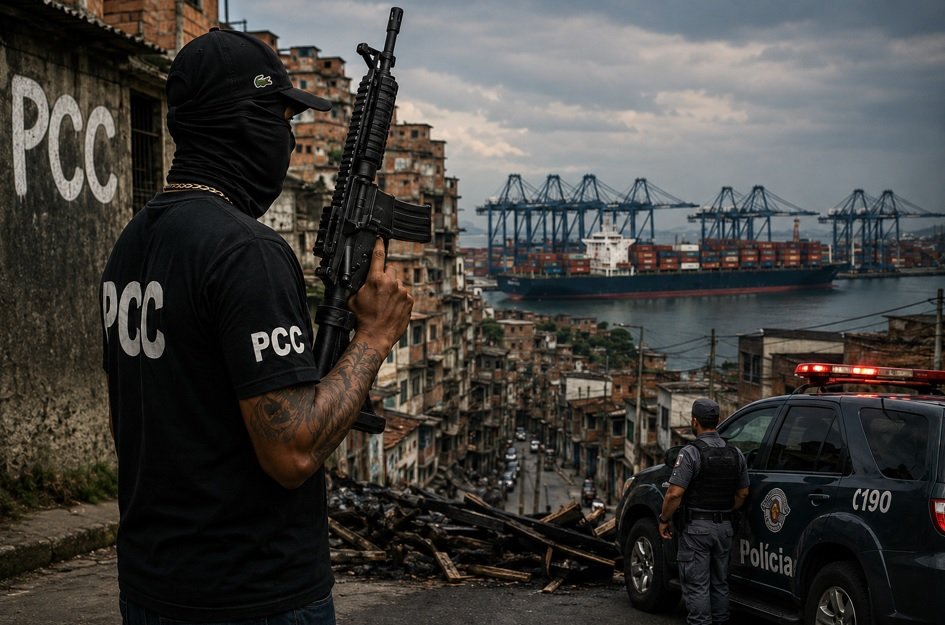
Twenty years after the coordinated attacks carried out against São Paulo’s security forces, the First Capital Command (PCC) continues to follow a strategy focused on avoiding direct and prolonged confrontations with police. According to investigators and security experts, the faction operates with a business-oriented logic in which violent clashes are viewed as harmful to its highly profitable drug trafficking operations. This approach prevails across most of the state of São Paulo, where the organization seeks to preserve stability in territories under its influence. The main exception is the Baixada Santista region, where residents have, for years, experienced the most violent and openly armed version of the faction’s activities. In cities such as Santos, Cubatão, and Guarujá, criminals openly display rifles on the streets and on social media, erect barricades, and frequently repel police patrols with gunfire. In several neighborhoods, routine preventive policing has effectively ceased, with security forces entering only during large-scale operations or in heavily armed convoys.
This Content Is Only For Subscribers
To unlock this content, subscribe to INTERLIRA Reports.
Police Don’t Enter
Military police officers and residents interviewed anonymously identified at least ten favelas in the region where regular patrols are no longer conducted due to the level of risk. According to those interviewed, Guarujá is considered one of the most critical areas in the Baixada Santista. One policewoman who has worked in the region for more than a decade summarized the situation by stating that “Guarujá is Rio de Janeiro 2,” a comparison referencing the intense armed presence and territorial disputes commonly associated with Rio’s favelas. Residents describe a daily reality marked by fear, armed criminal patrols, and restrictions imposed by traffickers, while police officers acknowledge that entering certain communities without tactical support is considered too dangerous.
Data
Figures from the São Paulo State Public Security Secretariat show that 28 people were killed in police interventions across the nine municipalities of the Baixada Santista during the first quarter of this year. The number already represents 57% of all deaths caused by police action recorded in the region throughout 2025, when 49 fatalities were registered. Since 2013, the beginning of the official historical series, 920 people have been killed in police operations in the Baixada. Of this total, 896 deaths resulted from actions by the Military Police and 24 from Civil Police operations. The region has also become one of the deadliest areas for law enforcement officers in the state. Over the past 20 years, at least 44 police officers have been killed within the territory covered by Deinter 6, the police department responsible for the Baixada Santista and nearby municipalities. Among the victims were 33 Military Police officers and 11 Civil Police agents.
Worst Period
The years 2023 and 2024 marked one of the most violent periods in the recent history of the Baixada Santista. The escalation began on July 28, 2023, after the murder of ROTA officer Patrick Bastos Reis, 30, in Guarujá. In response, the São Paulo Military Police launched Operations Escudo and Verão in several communities across the region. Together, the operations resulted in the deaths of 84 people during alleged confrontations with police forces. Human rights organizations and independent investigators later pointed to evidence suggesting the occurrence of extrajudicial executions, alleging that some victims had been cornered and shot in the back. The operations significantly contributed to the increase in police-related deaths in the region, which reached 132 fatalities in 2024. Although the Baixada Santista represents only about 4% of the state’s population, it accounted for approximately 16% of all deaths caused by police intervention in São Paulo that year.
Port
According to authorities, poor communities in the Baixada Santista have become strategic logistical bases for the PCC’s international drug trafficking operations through the Port of Santos, the largest port complex in Latin America. Several of these communities are located close to cargo terminals, facilitating the movement and concealment of narcotics before export. Federal Police delegate Rodrigo Perin Nardi, who works in Santos, stated that the faction takes advantage of the proximity between the communities and the port infrastructure to transport drugs more efficiently. Large cocaine seizures at the port can generate losses worth millions of dollars for the organization, which, according to investigators, explains the PCC’s investment in heavily armed security teams tasked with protecting stockpiles and trafficking routes. Police officers operating in the region report that attempts to approach these areas are frequently met with armed resistance and gunfire.
Analysis:
The situation in the Baixada Santista demonstrates how the PCC adapts its operational model according to the strategic importance of each territory. While the faction generally avoids prolonged confrontations with police in order to preserve the stability of its drug trafficking business, the port region has become an exception because of its direct connection to international cocaine export routes through the Port of Santos. In this context, the open display of rifles and pistols serves not only a defensive function but also a symbolic one. According to security experts, these armed displays are intended to demonstrate to residents and rival groups who effectively control the territory.
Baixada Santista exposes the limitations of relying exclusively on police force to retake territories dominated by organized crime. Specialists argue that tactical operations may temporarily reduce criminal activity or disrupt trafficking logistics, but they are insufficient to dismantle the broader structures sustaining faction control.
Sources: A Folha de SP; O Globo.

