


Summary
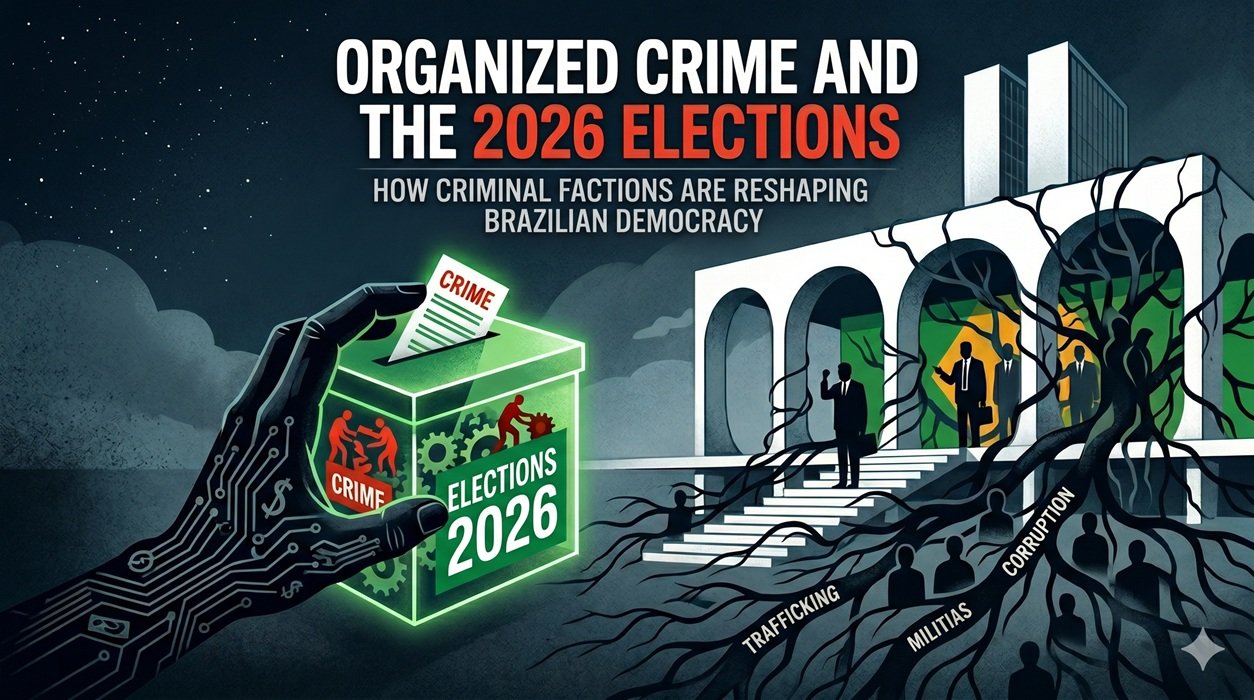
The 2026 elections in Brazil take place in a context where organized crime has moved beyond a public security issue and start to be debated and seen as a direct challenge to democratic institutions. Recent investigations and electoral data show that criminal factions are not only expanding territorial control and illegal economies but also financing campaigns and influencing local political dynamics. This debate unfolds alongside the implementation of new measures such as the Anti-Faction Law and the Brazil Against Organized Crime program, which seek to strengthen the state’s capacity to confront criminal networks.
This growing overlap has raised concerns about the integrity of the electoral process, leading electoral authorities to adopt stricter rules to prevent candidates with suspected ties to criminal groups from running. As a result, public security in 2026 becomes not only a policy debate, but also a democratic issue, where the boundaries between political representation and criminal influence are increasingly contested.
Inhabiting Power
The infiltration of organized crime into Brazilian politics has moved well beyond theory. There is now documented evidence that criminal factions are building influence networks inside state institutions themselves — no longer content with controlling territories and illegal economies, but actively intervening in the political process, financing campaigns, co-opting elected officials, and ensuring that public decisions serve criminal interests.
One of the most striking examples involves Álvaro Malaquias Santa Rosa, known as Peixão, leader of the Third Pure Command (TCP) in Rio de Janeiro’s Complexo de Israel. In March 2025, police demolished a luxury resort belonging to him — an ostentatious symbol of the parallel power exercised by drug trafficking in the area. Investigators later revealed, however, that the demolition could have happened 15 months earlier, had it not been for political interference. At least four sources from different agencies involved in planning the operation stated that two politicians had acted to cancel it: state deputy Roosevelt Barreto Barcelos, known as Val Ceasa (PRD), and former city councilman Ulisses Marins (União). Both reportedly visited the local police battalion to request that the property be spared, claiming a social project operated on the site. The connection is visible at the ballot box too: a survey by newspaper “O Globo” found that both politicians are consistently the top vote-getters in the very neighborhoods controlled by Peixão — whoever controls the territory has a huge influence on who will get the local votes.

A parallel Federal Police investigation into the Red Command (CV) revealed that Brazil’s largest criminal faction operates with a deliberate strategy of political recruitment, seeking allies who can provide institutional protection and influence over public decisions. The same investigation uncovered that CV members had improper access to draft judicial documents and prosecutor’s office files — including addresses listed in active search and seizure warrants — through a military police officer assigned to the state court of justice who was passing “highly sensitive and confidential” material to traffickers in exchange for bribes.
The phenomenon is not confined to Rio. São Paulo prosecutor Lincoln Gakiya, a Special Task Force for Combating Organized Crime (Gaeco) investigator who has been probing the First Capital Command (PCC) since 2004, warned that the faction has already financed campaigns for city councilors and mayoral candidates across São Paulo state. Intelligence reports identified dozens of candidates with PCC ties running in the 2024 municipal elections. According to Gakiya, the faction is not pursuing high-profile legislative seats — its focus is on local positions that allow direct access to public contracts and municipal services, the quieter levers of power that are harder to monitor and easier to exploit.

Taken together, these cases point to a coordinated pattern: organized crime in Brazil is not trying to overthrow the state — it is trying to inhabit it. As the 2026 elections approach, the question is no longer whether criminal factions have political influence, but how deep that influence already runs.
Public Security as an Electoral Issue
As the 2026 elections approach, public security is expected to become one of the most contested political issues in Brazil, building on an already documented pattern of growing criminal influence in electoral dynamics. Recent data and investigations indicate that this is not a new phenomenon, but one that has intensified with the expansion of criminal factions across the country, increasing pressure on electoral institutions to respond.
Evidence from the 2024 municipal elections illustrates the scale of the challenge. In the state of São Paulo, the Regional Electoral Court (TRE-SP) identified around 70 candidates with alleged links to criminal organizations, including the PCC. Of these, 12 were elected, among them mayors and city councilors, and many remain under investigation or prosecution in both electoral and criminal courts. A separate Federal Police investigation reported that criminal groups interfered or attempted to interfere in electoral outcomes in at least 42 municipalities nationwide, with estimates suggesting that the PCC invested millions of reais in supporting political candidates.

In response to this growing concern, electoral authorities have moved to tighten rules ahead of the 2026 elections. The Superior Electoral Court (TSE) adopted a stricter regulatory framework aimed at preventing candidates with suspected ties to organized crime from running. This shift builds on legal precedent in which the Court upheld the rejection of a candidacy linked to militia activity in Rio de Janeiro, based on constitutional provisions prohibiting the use of paramilitary organizations by political actors. For the first time, the Court has sought to expand preventive mechanisms beyond final criminal convictions, incorporating evidence-based restrictions into its electoral resolutions.
At the operational level, regional electoral courts have also begun to strengthen monitoring tools. In Rio de Janeiro, for example, the TRE is integrating intelligence data from security agencies to identify potential links between candidates and criminal groups, supported by dedicated investigative task forces. The goal is to allow the Electoral Public Prosecutor’s Office to challenge suspicious candidacies before the official campaign period begins, reducing the likelihood that individuals with ties to factions or militias reach elected office.
Against this backdrop, the 2026 campaign is likely to unfold under unprecedented scrutiny regarding criminal infiltration in politics. Electoral authorities, security agencies, and political actors are all engaged in drawing the boundaries of democratic participation — a contest that will itself be shaped, in part, by the same criminal networks they are trying to exclude.
Government Response
To counter expanding criminal factions, the Lula administration launched three interconnected initiatives in 2026. Together, they form a strategy of tougher legislation, federal coordination, and new funding—though congressional gridlock has slowed structural reform.
- The Anti-Faction Law (Enacted March 2026): This legislation established a formal legal definition of criminal factions, increased prison sentences, and expanded asset seizures. However, executive-legislative tensions led to Congress removing a key funding mechanism: the taxation of sports betting.
- The Public Security PEC: Designed to secure long-term financing, this constitutional amendment would direct 30% of betting tax revenues and a portion of pre-salt oil funds to security programs. While overwhelmingly approved by the Chamber in May 2026, it remains stalled in the Senate due to political disputes.
- Brazil Against Organized Crime (Launched early 2026): Bypassing legislative paralysis, the executive branch launched this program to demonstrate immediate action. Backed by R$1.06 billion in direct investment and a R$10 billion credit line for local governments, it funds prison security, financial intelligence, and anti-trafficking operations.
However, these measures are being implemented in a political environment already marked by evidence of criminal infiltration and sustained attempts by factions to influence electoral and institutional processes. This creates a structural tension between the design of public security policies and the context in which they must operate, particularly as key initiatives remain subject to legislative disputes and political bargaining.
As the 2026 elections approach, that tension becomes acute. The risk is not simply that these measures will fall short of their stated goals — it is that the electoral cycle itself may be captured before the tools designed to prevent that outcome are fully in place. Whether Brazil’s institutions prove strong enough to enforce the boundaries they are now drawing, or whether organized crime continues to exploit the gap between legislative ambition and political reality, will be one of the defining tests of the country’s democratic resilience in the years ahead.

