


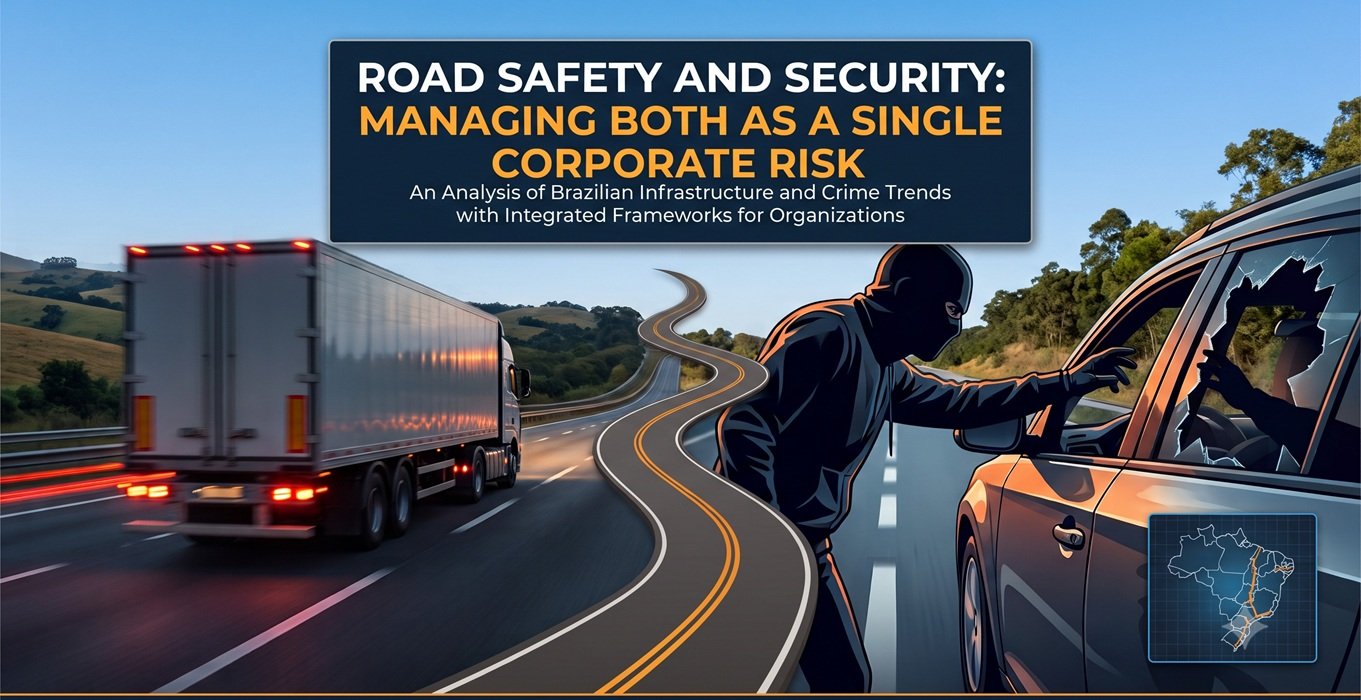
Summary
Managing road risk in Brazil requires confronting two distinct but overlapping threats: safety and security. While safety involves mitigating crashes, infrastructure failures, and human errors, security demands active defense against cargo theft, robbery, and carjacking. Corporate travel policies often treat these as separate domains, yet they frequently collide on the same stretch of highway. This analysis pairs recent Brazilian data on infrastructure and crime with a practical framework for organizations moving people, cargo, or executives across the country.
This Content Is Only For Subscribers
To unlock this content, subscribe to INTERLIRA Reports.
Why This Matters for Companies
Any company operating in Brazil—whether managing a heavy logistics fleet, a mobile sales team, or a commuting workforce—faces a compounding mix of safety and security exposures.
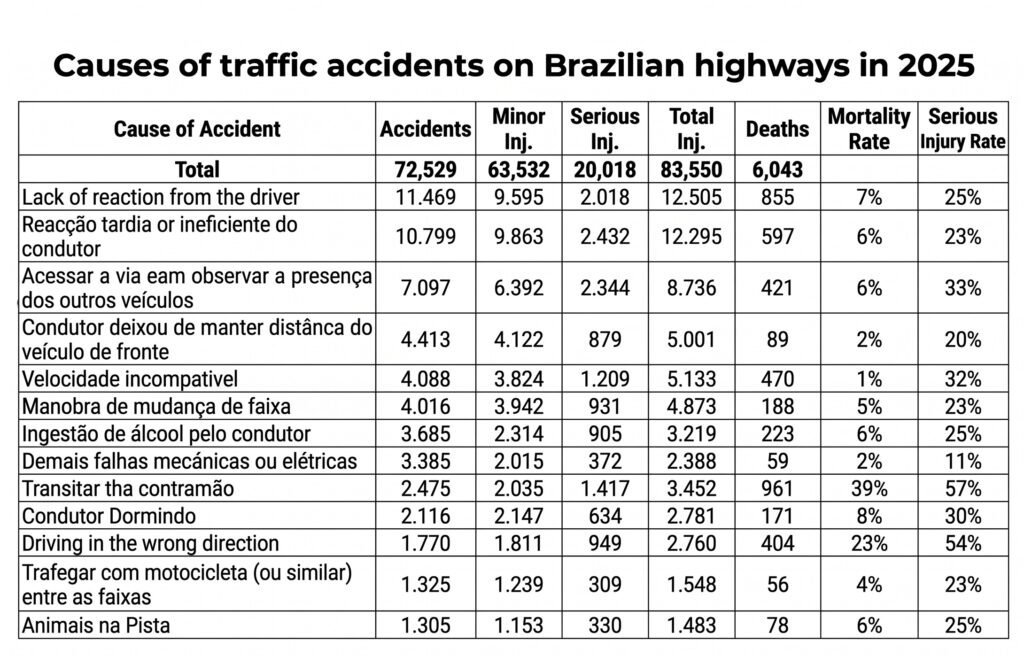
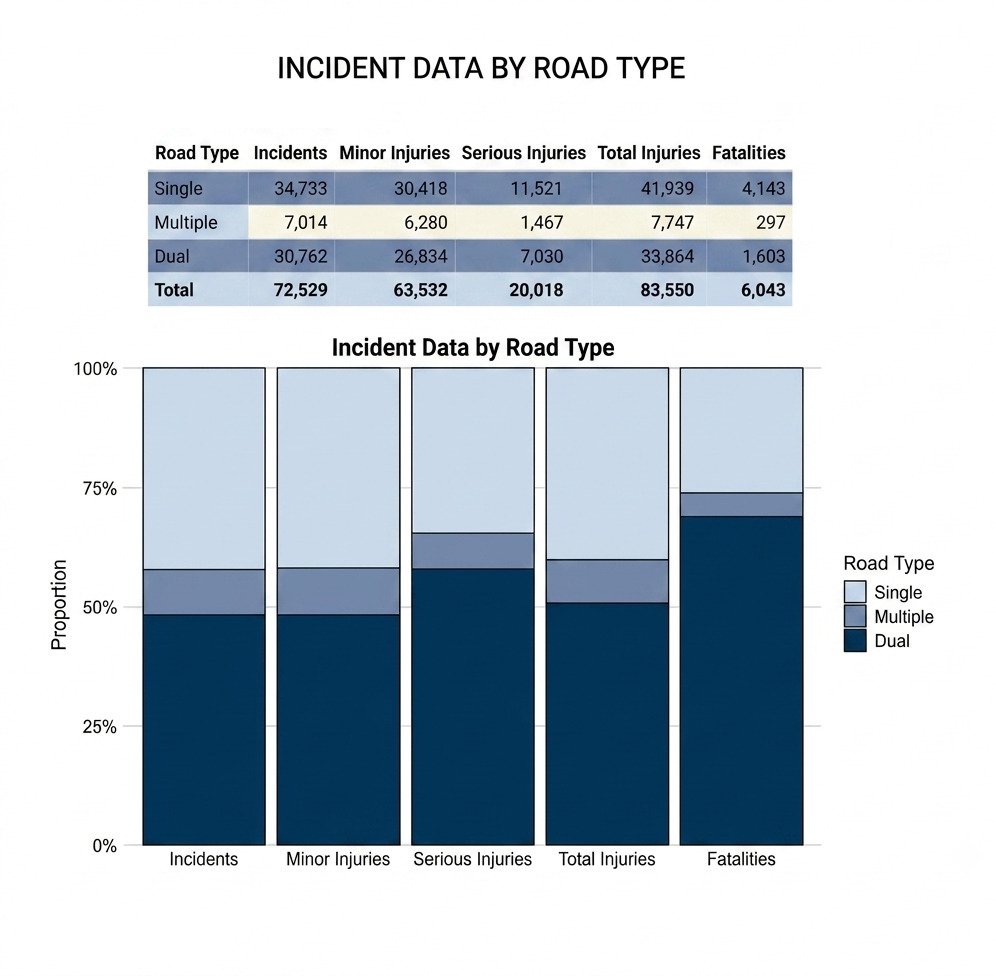
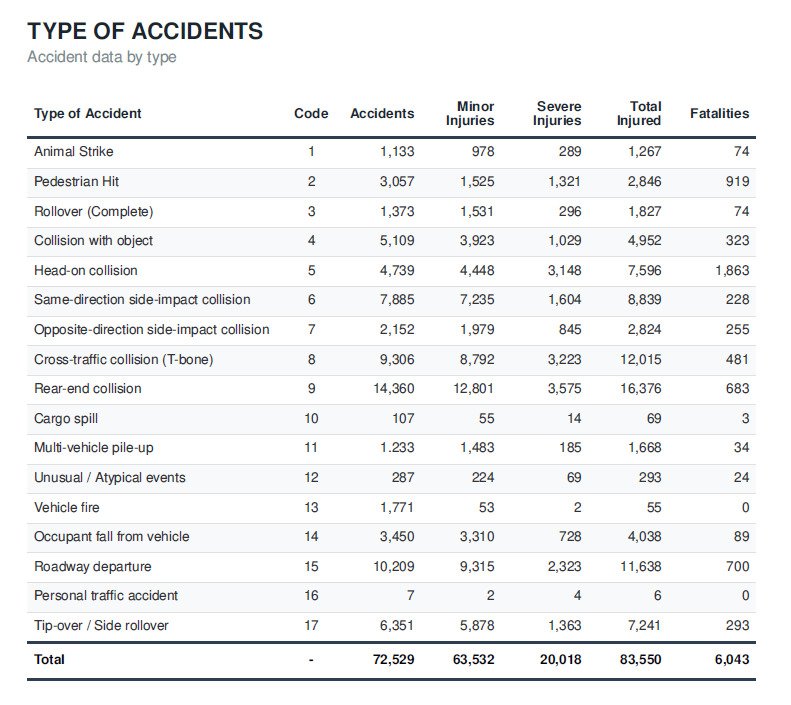
- The Bottom Line on Fleet Exposure: Crashes carry massive financial and legal liabilities, from vehicle downtime and spiking insurance premiums to wrongful-death litigation. To put the baseline risk into perspective, Brazil’s federal highways alone recorded 72,476 crashes and 6,040 deaths in 2025—averaging roughly 199 crashes and 16 fatalities every single day. This is the statistical reality baked into every route plan.
- The Reality of Human Exposure: Executives commuting between meetings, field teams log hours on provincial roads, and overnight cargo crews face elevated safety and criminal threats simultaneously. These risks frequently converge on the exact same corridor: a driver sitting at a red light with an open window is a target for a quick robbery, while that same moment of driver distraction creates an immediate collision risk from behind.
Treating safety and security as a single, unified risk category—rather than separate silos on a corporate risk register—is the only way an organization can genuinely reduce total road exposure instead of simply shifting the vulnerability elsewhere.
Infrastructure & Crash Dynamics: By the Numbers
A Failing Network Baseline: Brazil’s physical road infrastructure heavily compromises safety. The 2025 CNT[1] Highway Survey notes that 62.1% of the country’s main highway network rates as Fair, Poor, or Terrible, with 2,146 critical flashpoints threatening to disrupt logistics without warning. Furthermore, because 84.7% of the network remains single-lane, head-on collisions during unsafe overtakes remain a primary killer, accounting for 64.0% of federal highway deaths.
The Public vs. Private Safety Divide: Where an organization routes its vehicles matters. CNT’s Forgiving Highways Index shows that 50% of publicly managed highways rate as “Low Forgiveness” (poor guardrails and shoulders), compared to just 2.4% of private concession roads. A driver error on a public road in the North, Northeast, or Center-West is statistically far more likely to result in a fatality.
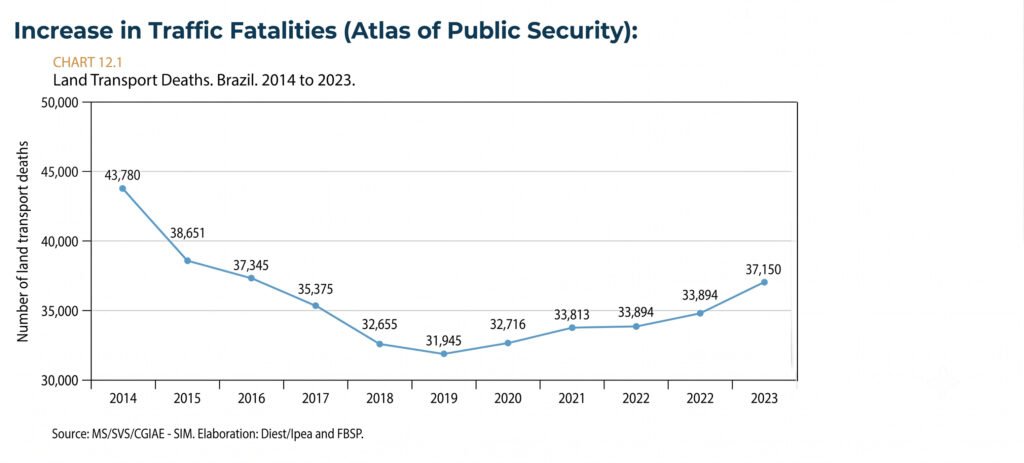
A Rising National Mortality Rate: The 2026 Violence Atlas confirms that Brazil’s roads are becoming more dangerous, with deaths climbing to 37,150 in 2024—a 13.6% mortality rate spike since 2019. While the boom in app-based deliveries has pushed motorcycle fatalities to over 40% of the national total, corporate fleets are heavily impacted: truck-occupant deaths rose 30.2% and bus-related deaths climbed 28.3%.
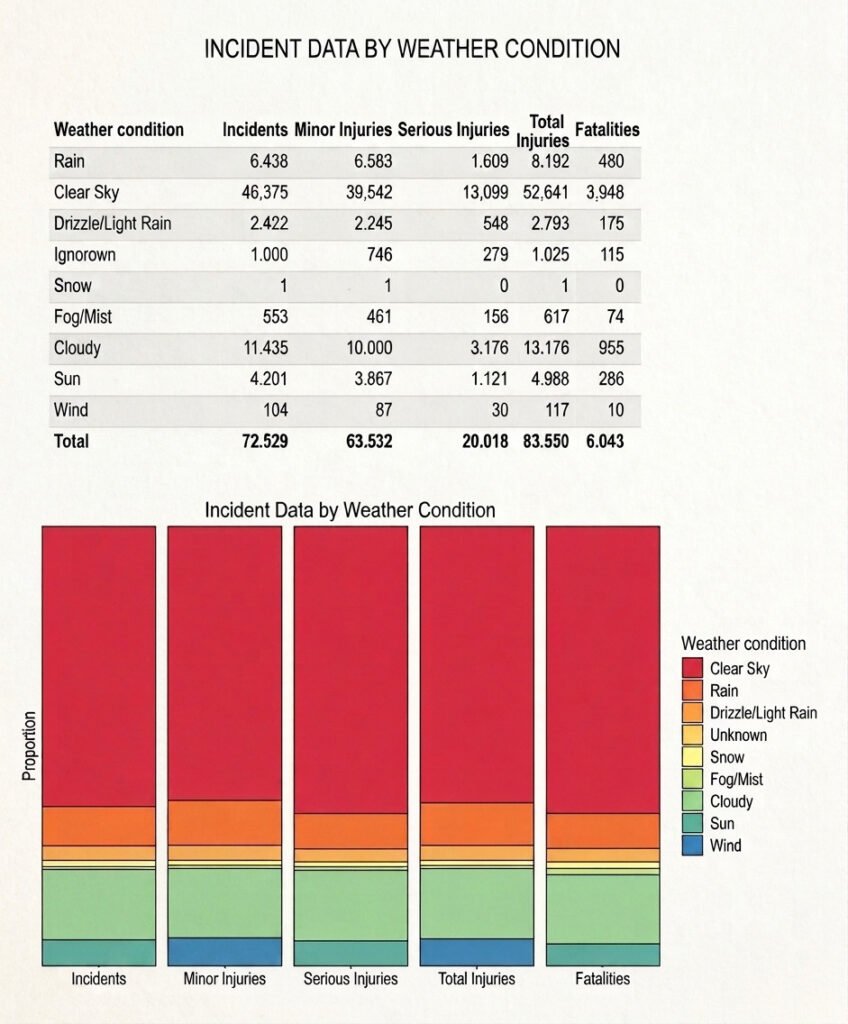
Source: Federal Police.
Key Municipal Indicators: Regional operations require tailored risk profiles. São Paulo reached a 10-year high with 1,034 traffic deaths in 2025, though localized speed-reduction initiatives are working in 28 specific municipalities. Meanwhile, Rio de Janeiro’s ISP-RJ explicitly tracks traffic fatalities alongside crime data, highlighting how closely intertwined safety and security are in the state’s risk landscape.
The Security Picture: Crime Trends on and around the Road
Brazil’s overall violent-crime trend is improving on the underlying data, even where public perception suggests otherwise. The 2026 Violence Atlas reports a 26.9% decline in the national homicide rate over the past eleven years, a divergence from public perception the report attributes partly to the prominence of public security in Brazil’s political and media agenda. For companies, this means objective and perceived risk diverge, with consequences for how travel policies are designed and communicated.
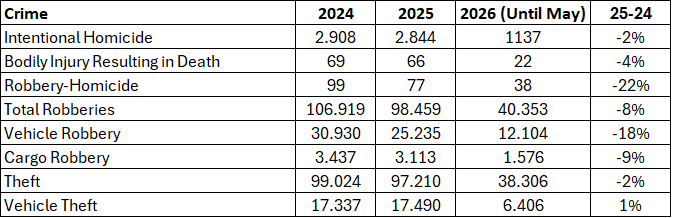
Vehicle- and cargo-related crime improved broadly in Brazil’s two largest crime markets between 2024 and 2025, though the states are starting to diverge. São Paulo recorded declines of 21.1% in vehicle robbery (31,696 to 25,024), 26.3% in cargo robbery, and 22.3% in armed robbery with fatal outcome (latrocínio), alongside a 3.1% drop in homicide. Rio de Janeiro moved similarly — vehicle robbery down 18.4%, cargo robbery down 9.4%, armed robbery with fatal outcome down 22.2%, homicide down 2.2% — though vehicle theft without the use of force, violence, or threats (furto) was essentially flat.
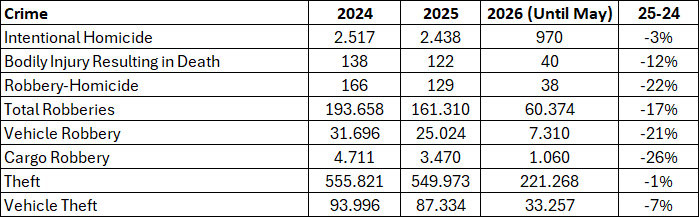
Partial 2026 data (January–May), however, point to a possible reversal in Rio de Janeiro on vehicle and cargo robbery specifically — both running well above their 2025 pace if annualized — even as São Paulo continues to improve across the board and RJ homicide keeps declining. Mobile-phone theft is rising in both states even as vehicle and cargo robbery fall, a reminder that low-effort opportunistic crime remains distinct from organized vehicle crime. The takeaway for fleet and travel-security planning: state averages can mask shifts within a year, so city- or route-level risk should be reassessed periodically.
Vehicle theft remains large in absolute terms even as rates fall — Brazil averages roughly 64 vehicle thefts and robberies per hour, per SUSEP’s Stolen Vehicle Index[2]. Mass-market hatchbacks (Volkswagen Gol, Hyundai HB20, Fiat Uno) remain the most-targeted models by volume, chosen for high circulation and cheap parts, while SUVs are a growing target category where losses can exceed R$100,000 once repairs and premium increases are included. Statewide in São Paulo, vehicle robbery and theft combined for 112,358 cases in 2025 — still a substantial base despite the year-over-year decline.
There is a distinct paradox in corporate mobility choice: the transit modes that perform best on safety statistics—namely, public transportation—are often the ones most avoided for security reasons. This aversion persists even when security improves, such as in Rio de Janeiro, where robberies aboard public transit dropped by 60% year-over-year. Automatically defaulting every employee to a private vehicle under the guise of “security” may actually increase an organization’s aggregate risk exposure by placing more drivers on Brazil’s high-fatality highways.
Reducing the Risk of a Crash
The fundamentals of defensive driving are well established and should form the baseline of any corporate driver policy.
Vehicle and driver readiness. Confirm valid documentation and licensing before any trip, and check brakes, tires, fluids, and lighting.
Route planning. Where practical, use CNT’s Highway Survey data to avoid degraded pavement and known critical points, favoring concession highways when a reasonable alternative exists — navigation apps optimize for time, not safety.
Mobile Distraction. Mobile phone use—including hands-free texting, scrolling, or setting up navigation while moving—is a primary driver of fatal incidents.
Active Situational Awareness. Drivers must actively scan 15–20 seconds ahead to anticipate sudden traffic stops, unlit road debris, and erratic motorcycle behavior. Continuous environmental scanning grants the crucial reaction time needed to spot both safety hazards and security threats before they escalate.
Fatigue management. Many Brazilian crashes are linked to drowsiness, especially overnight and mid-afternoon; applying rest-break discipline to non-professional drivers on long trips is a reasonable precaution. Drivers are also most vulnerable to both fatigue and security threats right before reaching their destination.
Behavioral and Regulatory Discipline. Respecting the rules of the road means maintaining a safe following distance, strictly observing speed limits, and enforcing universal seatbelt compliance.
Source: Federal Police.
Reducing the Risk of a Crime
Security risk calls for a different skill set than standard driving courses typically cover.
Space and positioning. At a stop, keep enough distance from the vehicle ahead to preserve room to maneuver, and avoid lanes where the vehicle could become boxed in.
Reading the environment. Personnel can be trained to notice recurring patterns — a motorcycle with two riders on an unusual trajectory, or a vehicle mirroring lane changes over distance — that close-protection specialists treat as early indicators.
Reducing passive exposure. Keep windows closed and valuables out of sight and stay alert during the final stretch of a trip, when attention naturally drops.
If an approach occurs. Personal safety comes first: stay calm, keep hands visible, avoid sudden movements, and hand over valuables without hesitation.
Source: Federal Police.
Structured Training
These disciplines are core modules in specialized corporate courses, of the kind delivered by INTERLIRA’s expert trainers. Drawing from specialized backgrounds in elite tactical units and high-profile personal protection, these instructors inject a sophisticated layer of situational awareness and threat detection that standard defensive-driving programs simply do not include. This expertise ensures drivers are trained not just to handle vehicle physics, but to actively read the environment for security anomalies.
Conclusion
Safety and security on Brazilian roads are not competing priorities; they are two readings of the same exposure. Infrastructure data shows that half of Brazil’s public highway network offers a road design unlikely to mitigate the consequences of a driver’s mistake, while crash data shows human error is overwhelmingly the proximate cause when incidents occur. Crime data, in parallel, shows that criminal risk against vehicles, cargo, and personnel is real but concentrated in identifiable patterns — and, in the most recent Rio de Janeiro figures, moving in a more favorable direction than public perception generally acknowledges. An organization that trains drivers on both dimensions and plans routes using the best available infrastructure data closes the gap between where accidents and crimes actually occur and where most corporate travel policies currently focus their attention.
INTERLIRA’s Integrated Solution
INTERLIRA brings this integrated approach directly to corporate clients through a comprehensive suite of protective services. These include data-driven route risk assessments utilizing the precise infrastructure and crime metrics referenced in this report, alongside specialized training to bridge the gap between defensive driving and threat-pattern recognition.
Crucially, INTERLIRA provides real-time operational oversight by actively monitoring safety and security events across our clients’ specific areas of interest. By tracking client vehicles against this live threat intelligence, INTERLIRA dynamically alerts operators and drivers the moment an asset is in close proximity to an active safety hazard or security event—providing immediate, actionable situational intelligence to facilitate the response.
[1] CNT stands for Confederação Nacional do Transporte (National Confederation of Transport), which is Brazil’s leading advocacy, research, and umbrella organization representing the entire domestic transportation and logistics sector.
[2] The SUSEP Stolen Vehicle Index—known in Brazil as the IVR (Índice de Veículos Roubados)—is an official statistical database maintained by the Superintendency of Private Insurance (SUSEP), Brazil’s federal insurance regulator.

