


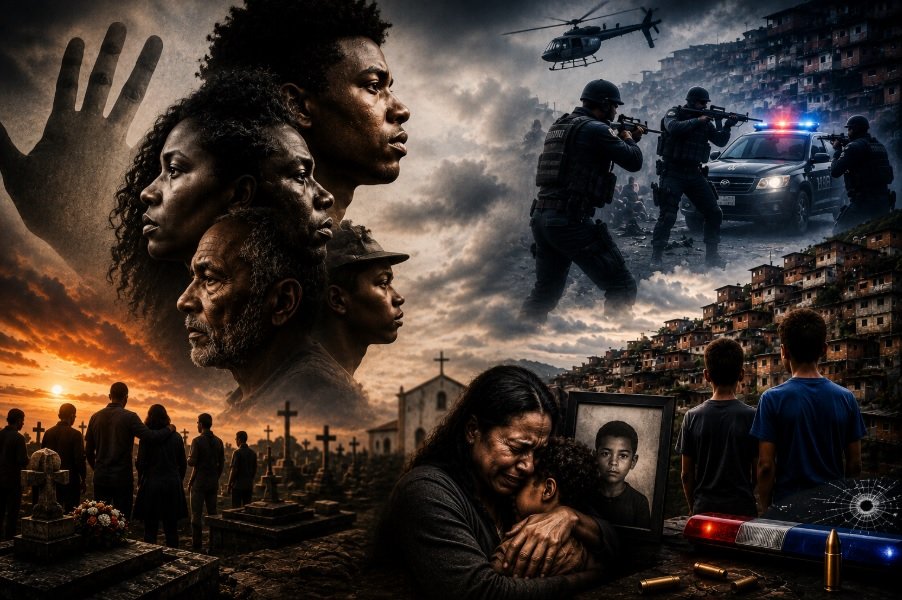
Black and mixed-race individuals—particularly young men—accounted for seven out of every ten deaths resulting from police intervention last year across nine Brazilian states, according to a report released on Wednesday (01/07) by the Security Observatories Network. The study defines the Black population as the combined total of Black and mixed-race individuals. Although this proportion declined slightly from 75% in 2024 to 70% in 2025, it remains significantly higher than the share of Black people in the overall population of the states analyzed. The report recorded 4,330 deaths resulting from police intervention across Amazonas, Bahia, Ceará, Maranhão, Pará, Pernambuco, Piauí, Rio de Janeiro, and São Paulo, compared with 4,069 in the previous year, representing a 6.4% increase in police lethality.
This Content Is Only For Subscribers
To unlock this content, subscribe to INTERLIRA Reports.
Going Against the Trend
The increase in police lethality contrasts with the broader decline in violent crime observed nationwide. According to the Ministry of Justice, Brazil recorded 31,481 homicide victims last year, a 10.4% reduction compared to 2024. Across the nine states included in the report, the decrease was smaller, at 8.5%. Black people also remain disproportionately represented among homicide victims. According to the latest Brazilian Public Security Yearbook, they account for 79% of all murder victims nationwide, despite representing 55.5% of Brazil’s population, according to the most recent IBGE census. At the same time, seven of the nine monitored states recorded increases in deaths resulting from police intervention between 2024 and 2025. Only Piauí and Bahia registered declines, with police-related fatalities falling by 16.7% and 7.7%, respectively.
Bahia: Highest Number of Deaths
Despite the decline, Bahia remained the state with both the highest absolute number of deaths caused by police intervention and the highest rate per 100,000 inhabitants. After reaching a record 1,702 police-related deaths in 2024, the state recorded 1,570 cases in 2025. Although Black people represent 79.7% of Bahia’s population, they accounted for 93.9% of those killed by police, totaling 1,243 victims. According to the report, the state remains under constant pressure due to disputes involving more than 20 criminal factions competing for control of drug trafficking routes and retail markets. Police-related fatalities were heavily concentrated geographically, with just 12 of Bahia’s 417 municipalities accounting for half of all recorded cases. Fatal incidents occurred on 346 of the year’s 365 days, and more than 1,000 victims were between 18 and 29 years old. Over the past seven years, police forces in Bahia have killed 8,743 people, exceeding the combined totals recorded by any of the other monitored states.
Rio de Janeiro
According to the report, the persistence of the “narco-terrorism” narrative has reinforced a public security strategy centered on armed confrontation. Rio de Janeiro recorded 800 deaths resulting from police intervention in 2025, including two children aged 11 or younger, representing a 13.8% increase compared to the previous year. More than half of these deaths (56.3%) occurred in the state capital. Although Black people account for 57.8% of Rio de Janeiro’s population, they represented 89.5% of those killed by police. The report estimates a police lethality rate of 6.3 deaths per 100,000 Black residents, compared with 1.1 per 100,000 among white residents, indicating that Black individuals were nearly six times more likely to be killed during police interventions.
São Paulo
São Paulo recorded a historic high of 834 deaths resulting from police intervention in 2025, representing a 2.7% increase compared to the previous year. The report notes that this increase occurred despite continued declines in major crimes such as theft, robbery, and robbery-homicide, suggesting that the rise in police lethality cannot be explained solely by crime trends but may also reflect operational and policy decisions. The city of São Paulo accounted for 30.5% of all police-related fatalities in the state. While Black people represent 40.9% of the state’s population, they accounted for 64.6% of those killed during police operations.
Children Killed
The report also found an increase in the number of children and adolescents killed during police interventions across the nine monitored states. A total of 312 victims aged 17 or younger were recorded in 2025, 15 more than in the previous year. Bahia registered the highest number of juvenile victims, with 152 adolescents aged between 12 and 17 killed during police operations. Rio de Janeiro ranked second, recording 44 victims aged 12 to 17, in addition to two children aged 11 or younger.
Analysis:
The report illustrates a persistent challenge in Brazilian public security: the coexistence of declining homicide rates with rising deaths resulting from police intervention. This divergence suggests that reductions in overall violence do not automatically translate into less lethal policing. Instead, operational strategies, institutional incentives, and the security environment in specific regions appear to play a decisive role in shaping police use of force. In states where criminal organizations remain heavily armed and territorially entrenched, security forces often conduct high-risk operations that increase the likelihood of deadly confrontations.
The racial disparities identified in the report also deserve careful attention. The consistent overrepresentation of Black victims across multiple states indicates that the issue extends beyond isolated incidents and reflects broader structural patterns. These disparities are influenced by a combination of socioeconomic inequalities, the geographic concentration of police operations in vulnerable communities, and the demographic composition of neighborhoods where organized crime is most active.
Sources: G1 [1], [2]; O Globo; A Folha de SP.

