


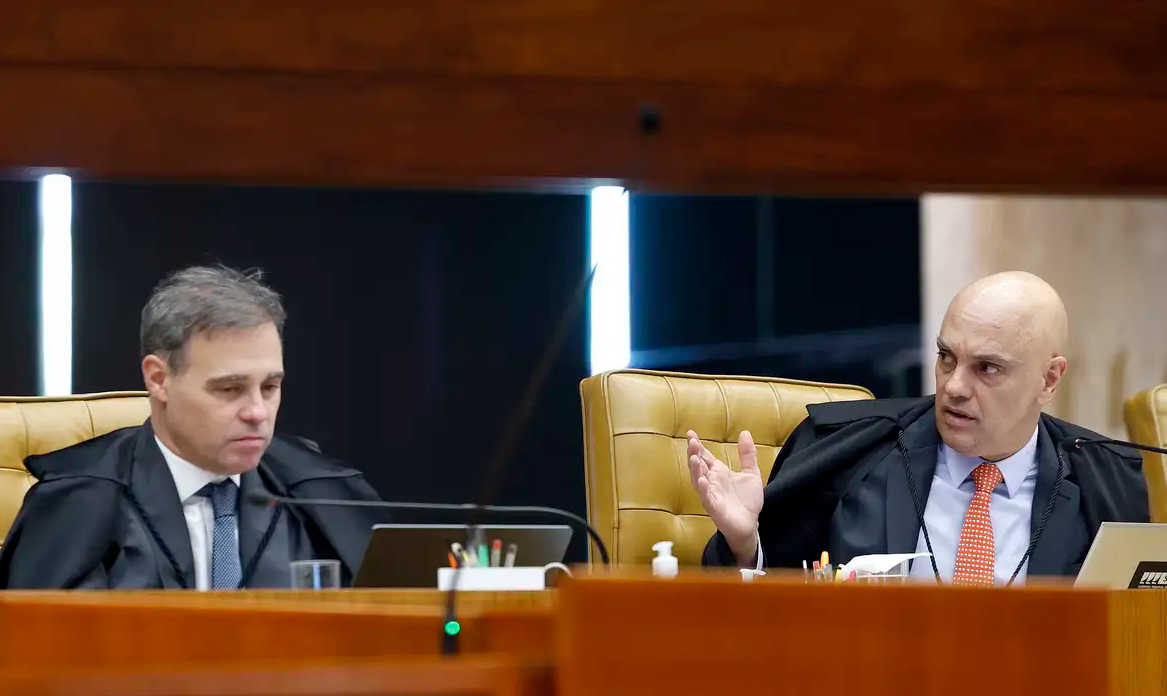
The controversy surrounding Banco Master and its former owner, Daniel Vorcaro, has expanded beyond a financial and judicial case to become a potentially significant institutional crisis with direct repercussions for Brazil’s political balance and the 2026 presidential race. The disclosure of Federal Police material allegedly showing contacts and meetings between Vorcaro and Supreme Federal Court (STF) Justice Alexandre de Moraes—including discussions involving a R$131 million contract between Banco Master and the law firm headed by Moraes’s wife, Viviane Barci de Moraes—has intensified scrutiny of the relationship between political and economic interests and members of the judiciary. The dispute has further escalated following Justice André Mendonça’s decision to lift the confidentiality of the material, Moraes’s subsequent request for an investigation into Mendonça, and STF President Luiz Edson Fachin’s intervention to contain the growing confrontation within the Court. Meanwhile, opposition presidential candidates have used the revelations to renew calls for Moraes’s impeachment, while the controversy surrounding alleged Banco Master financing of the film Dark Horse, linked to former President Jair Bolsonaro’s political circle, has created potential liabilities for both the Bolsonaro camp and its opponents. Against this backdrop, the crisis has also generated repercussions for President Luiz Inácio Lula da Silva and members of his political environment, while recent electoral polls indicating an increasingly competitive race suggest that the institutional turmoil may become an important—though not yet measurable—factor in shaping Brazil’s political landscape in the period leading up to the 2026 elections.
This Content Is Only For Subscribers
To unlock this content, subscribe to INTERLIRA Reports.
Moraes and Vorcaro
Messages extracted from banker Daniel Vorcaro’s mobile phone by the Federal Police (PF) revealed a series of interactions with a contact saved under the name Alexandre de Moraes. The messages indicate possible interactions between Vorcaro and the Supreme Federal Court (STF) Justice, as well as with individuals linked to Moraes’s family. The exchanges show the banker pressing for special attention regarding payments on a R$ 131 million contract signed between Banco Master and the Barci de Moraes law firm, led by Viviane Barci de Moraes—the Justice’s wife. The messages, initially disclosed by the newspaper “O Estado de S. Paulo”, had their confidentiality lifted by a decision from Justice André Mendonça on September 1.
Messages obtained by the Federal Police (PF) from Daniel Vorcaro’s mobile phone indicate that he met with Supreme Federal Court (STF) Justice Alexandre de Moraes at least six times. The initial meetings were arranged by Federal Deputy Fábio Faria. The first of these reportedly took place on February 2, 2024. The last recorded meeting occurred in April 2025.
Moreover, the metadata collected by the PF indicates that Justice Alexandre de Moraes of the Supreme Federal Court (STF) made edits to a R$ 131 million contract between the law firm of his wife, Viviane Barci de Moraes, and Banco Master—owned by Daniel Vorcaro—before the document was signed.
Moraes’ Reaction
In response to the documents revealed by Mendonça, Supreme Federal Court (STF) Justice Alexandre de Moraes has requested an investigation into his counterpart for abuse of authority, administrative misconduct, and an impeachable offense regarding his handling of the Banco Master and INSS (National Social Security Institute) case. The STF Justice issued a ruling in the “fake news” inquiry, stating that his colleague acted out of personal and political motives and steered the investigations. Cell phone data arrived at the Justice’s office before being submitted to the technical analysis.
Pressure for Impeachment
Presidential candidates Flávio Bolsonaro (PL), Ronaldo Caiado (PSD), and Romeu Zema (Novo) called September 1 for the removal of Supreme Federal Court (STF) Justice Alexandre de Moraes following the revelation of messages exchanged with Daniel Vorcaro of Banco Master. President Lula (PT), meanwhile, has not commented on the matter. Flavio has previously expressed support for Moraes’s impeachment; because he serves as the rapporteur for the cases regarding the coup plot that culminated in the imprisonment of former President Jair Bolsonaro (PL).
Senate President Davi Alcolumbre (União Brasil-AP)—a key figure in orchestrating the impeachment of a Supreme Court justice—has signaled that he is reluctant to support a petition against Justice Moraes. When asked about the matter, he stated: “(…) Everyone has forgotten that they asked the same person for R$ 130 million—referring to Flávio Bolsonaro and the resources he collected for his farter’s biographic movie, Dark Horse —to make a movie. And now, the ones to blame are Justice Alexandre de Moraes and me.”
Mendonça and Vorcaro Also Met
However, Moraes was not the only minister to meet with Vorcaro. In fact, Mendonça himself met with the banker and he acknowledged the meeting, on September 2, for a conversation that occurred in March 2025. The private meeting took place off the official schedule and outside the court, at the offices of the Iter Institute—an organization founded by the justice to provide training, professional development, and public speaking courses. The justice states that he merely listened to the former banker and subsequently voted against his interests. In his statement, Mendonça notes that Vorcaro sought to engage with other justices regarding court-ordered government debts, a matter then under review by the STF that was of interest to Banco Master.
Fachin
Supreme Federal Court (STF) President Luiz Edson Fachin ordered Justices André Mendonça and Alexandre de Moraes, Prosecutor General Paulo Gonet, and Federal Police Director General Andrei Rodrigues to provide information within five days regarding a Federal Police report on messages sent by Daniel Vorcaro that identify Moraes as a recipient. He also removed the request to open an investigation—filed by Alexandre de Moraes against André Mendonça—from the “fake news inquiry,” amidst an escalating crisis within the court. Fachin advocated for ending this inquiry and for approving a proposed code of ethics for the court.
STF Justice Cármen Lúcia seems to be seen now as the deciding factor, since she sees errors on the part of both Justice André Mendonça and Justice Alexandre de Moraes regarding the actions that placed the court at the epicenter of an institutional crisis; she has not yet decided which of them will receive her support. Moraes and Mendonça are vying for Cármen’s vote in a bid for hegemony among their respective factions within the Supreme Court, and the justice’s position is considered decisive for the deliberations the full court is expected to hold regarding the conduct of both justices.
More on Dark Horse
Amidst the STF crisis, more information about the Dark Horse funding was revealed. According to Piauí Magazine, Daniel Vorcaro made an additional transfer of US$ 1.6 million to the fund responsible for managing resources for the film that tells the story of former president Jair Bolsonaro. The feature film is at the center of controversy, damaging the candidacy of Senator Flávio Bolsonaro (PL-RJ) for the Presidency, following the revelation of audio recordings in which he asks the then-owner of Banco Master for R$ 61 million to complete the project.
Moreover, a plea bargain statement by Antônio Carlos Freixo Júnior reveals that the businessman was responsible for making financial transfers and securing cash for Daniel Vorcaro, of Banco Master, sometimes using suitcases. Among the transfers made by Mineiro were funds destined for the U.S.-based fund used to finance Dark Horse. This fund, named the Havengate Development Fund, is managed by Paulo Calixto, a lawyer linked to former Congressman Eduardo Bolsonaro. Authorities suspect that a portion of the funds may have been allocated to Eduardo.
Impact on Lula and More
The Workers’ Party member and his political group are seeking to distance themselves from Moraes—with whom they had been close in recent years—in an attempt to prevent the case from tainting his re-election campaign.
While seeking to distance himself from the “Master” case and Justice de Moraes, President Lula (PT) is also trying to minimize the potential impact of the investigations concerning his son. On Thursday (27), during an interview, Lula stated that the accusations against his son, Fábio Luís Lula da Silva, are mere “speculation,” but that his son must defend himself and that there will be no government interference. He also said that he does not know the lobbyist and businesswoman Roberta Lucshinger, suspected of engaging in influence peddling within the federal government by leveraging his friendship with Fábio Luis. However, the lobbyist has been in photos alongside Luiz Inácio Lula da Silva posted on her Instagram account.
6X1 Shift
Senator Omar Aziz (PSD-AM) released the report this Thursday (27) on the proposed constitutional amendment (PEC) that reduces the workweek and eliminates the 6×1 work schedule. The lawmaker acceded to the Lula administration’s wishes and retained the text approved by the Chamber of Deputies in May. Consequently, the proposal is ready for a vote next Wednesday (2) in the Senate Constitution and Justice Committee (CCJ). The Lula administration is racing to approve the end of the 6×1 schedule before the election, aiming to leverage the issue during the campaign.
Andrei Rodrigue’s
The most recent “casualty” of this crisis was Federal Police Director Andrei Rodrigues, who was removed from his position on Tuesday (8), after a decision by the Second Panel of the Supreme Federal Court (STF), which formed a majority to uphold Justice André Mendonça’s order of maintaining his removal. However, the proceedings were suspended after Justice Gilmar Mendes requested a review of the case. The primary basis for the removal was an internal report produced by the Federal Police and used by Justice Alexandre de Moraes to request an investigation into Mendonça himself for abuse of authority, administrative misconduct, and an impeachable offense.
The Result at the Polls
According to the BTG/Nexus poll, Flávio Bolsonaro appears numerically ahead of Luiz Inácio Lula da Silva for the first time in a simulated runoff. The PL senator holds 46% of voting intentions, compared to the president’s 45%. The one-percentage-point difference falls within the margin of error, constituting a statistical tie. The survey was released this Tuesday (08). In the previous round, Lula had 46% and Flávio 45%. Now, the senator has shifted up by one point and the president down by one point. This shift appears in a poll conducted after nearly a week of news coverage regarding the crisis at the Supreme Federal Court and the Banco Master case; however, the survey does not allow the fluctuation to be attributed to that episode.
A Quaest poll commissioned by Globo and released this Monday (7) presents five runoff scenarios. In the matchup between Lula and Flávio, both hold 41% of voting intentions. The president’s support shifted from 42% in the September 2 poll to 41% now, while the senator’s figure remained unchanged. The margin of error is two percentage points. Lula is also statistically tied with Caiado and Cury.
Analysis:
The political significance of the Banco Master affair rests on concrete institutional developments rather than merely on the political controversy surrounding the individuals involved. Material extracted by the Federal Police from Daniel Vorcaro’s phone and subsequently made public has placed Justice Alexandre de Moraes under intense scrutiny because of his alleged contacts with the banker and the business relationship between Banco Master and the law firm headed by Moraes’s wife. Importantly, however, the available material and public reporting do not by themselves establish criminal liability or prove that Moraes acted improperly on Vorcaro’s behalf. The political crisis intensified because the revelations triggered an institutional confrontation within the Supreme Federal Court itself: Justice André Mendonça pursued inquiries connected to the case, while Moraes accused Mendonça of misconduct and sought an investigation against him. The dispute subsequently expanded beyond the two justices, with STF President Luiz Edson Fachin intervening and demanding explanations from those involved. The removal of Federal Police Director Andrei Rodrigues further demonstrated that the conflict had begun affecting other state institutions, transforming a case initially centered on Banco Master into a broader test of the STF’s ability to manage allegations involving its own members.
The electoral implications are also increasingly measurable, although a direct causal relationship between the Banco Master crisis and voting intentions cannot yet be established. The BTG/Nexus poll released on September 8 showed Flávio Bolsonaro with 46% and President Luiz Inácio Lula da Silva with 45% in a simulated second-round contest—a one-point difference that remains within the poll’s margin of error and therefore constitutes a statistical tie. The survey nevertheless illustrates the political context in which the institutional crisis is unfolding: Brazil’s presidential race has become highly competitive, leaving both major political camps vulnerable to reputational damage. The right can use the allegations involving Moraes to reinforce its longstanding criticism of the Supreme Court, particularly because Moraes played a central role in proceedings against former President Jair Bolsonaro. At the same time, revelations concerning Vorcaro’s alleged financial and political connections with figures associated with Bolsonaro—including questions surrounding the financing of Dark Horse—complicate attempts to portray the scandal as exclusively damaging to Lula or the political left. The most defensible political conclusion, therefore, is not that the Banco Master case has already changed the electoral outcome, but that it has introduced a new source of uncertainty into an exceptionally close race while potentially damaging public confidence in institutions that will play a central role in guaranteeing the legitimacy of the electoral process.
Sources: BBC; O Globo; A Folha de SP [1], [2], [3], [4], [5], [6], [7], [8], [9], [10], [11], [12], [13], [14], [15], [16], [17], [18], [19], [20], [21], [22], [23], [24], [25], [26], [27].

