


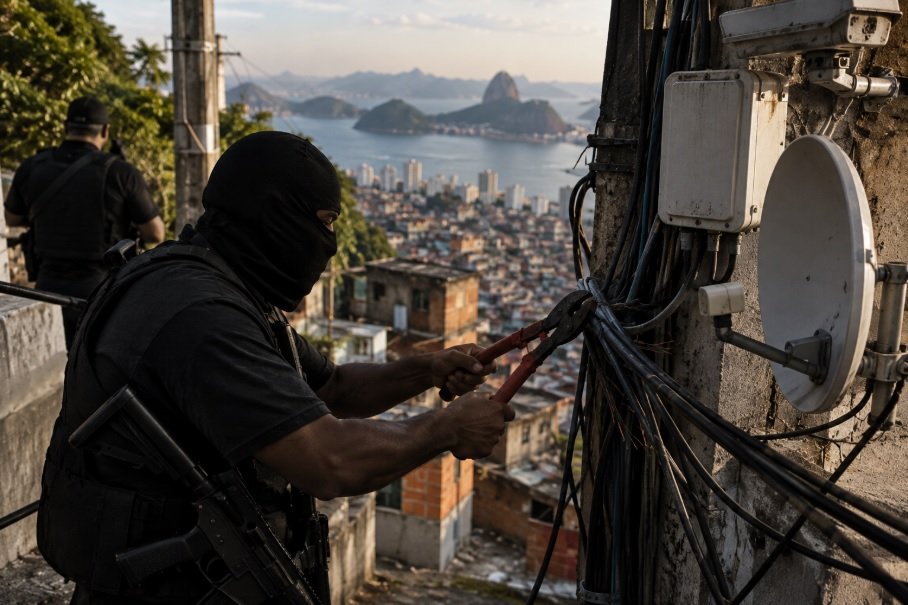
Armed groups linked to criminal factions have expanded their control over internet services in Rio de Janeiro through intimidation, sabotage, and the forced exclusion of legitimate providers. In Itaboraí, armed men reportedly invaded a residential condominium on August 31, 2026, destroyed internet cables and security cameras, threatened a doorman, and pressured residents to use a clandestine network. Three suspects were arrested. At the same time, a Civil Police investigation into the Boogie Woogie community, on Ilha do Governador, identified a scheme in which legal internet providers were allegedly co-opted by the Terceiro Comando Puro (TCP), while major operators and their technicians were prevented from entering the area.
This Content Is Only For Subscribers
To unlock this content, subscribe to INTERLIRA Reports.
Forced Monopoly
The cases are more examples that confirm criminal groups’ new tactics to move beyond conventional territorial control and drug sales. They are systematically establishing monopolies over essential services. According to investigators, legitimate providers have been excluded through threats, destruction of infrastructure, and restrictions on technicians’ access, leaving residents with little or no alternative but to contract services associated with the criminal scheme. In Boogie Woogie, police reportedly identified barricades controlling access to the community and evidence of interference with telecommunications infrastructure.
Violence Against Infrastructure
The Itaboraí incident demonstrates how criminal enforcement can directly target both physical infrastructure and security systems. The attackers allegedly used automatic rifles to enter the condominium, removed internet cables, fired at cameras and cut wiring, and threatened the doorman. The use of violence against residential security and communications infrastructure increases the vulnerability of communities and businesses operating in areas affected by criminal territorial control.
Operational Implications
The reported schemes highlight a broader risk of criminal exploitation of critical and essential infrastructure. Control over communications networks can generate recurring illicit revenue while also giving criminal organizations greater influence over residents, businesses, and service providers. For companies operating in or around affected areas, this can translate into service disruption, restricted access for employees and contractors, intimidation, equipment damage, and increased dependence on local actors controlled by criminal groups. This represents a security concern that extends beyond telecommunications and should be considered part of the broader risk environment associated with organized crime and territorial control.
Analysis:
The two cases suggest an evolution in the way organized crime exploits local infrastructure in Rio de Janeiro. Rather than relying solely on drug trafficking or territorial control, criminal groups are increasingly seeking to capture legitimate economic activities and transform essential services into sources of revenue and influence. The reported cooperation between criminal factions and nominally legitimate providers is particularly significant because it can create a hybrid structure in which legal businesses become instruments for sustaining criminal monopolies.
From a corporate security perspective, the main concern is the convergence of territorial control, infrastructure vulnerability, and coercion. Companies operating in communities or strategic areas where criminal groups exercise influence should consider telecommunications, access control, contractor movements, and physical infrastructure as interconnected security risks. The cases also demonstrate that attacks against seemingly ordinary services can be used to reinforce criminal governance and restrict the operational freedom of legitimate companies.
Sources: O Globo; A Folha de SP.

