


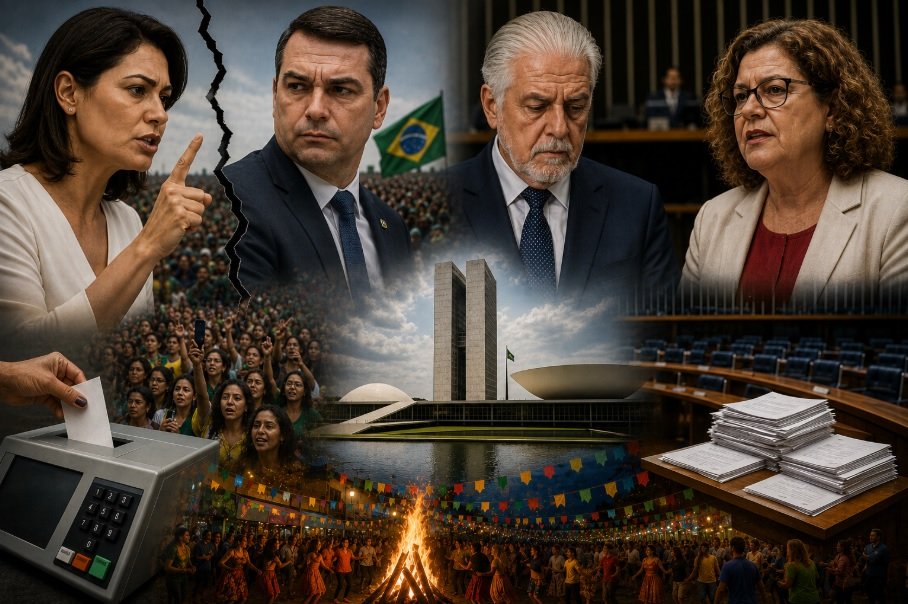
Brazil’s political scene was shaken this week by a public family rift, a high-profile resignation, and a temporary pause in contentious legislation. Former First Lady Michelle Bolsonaro publicly broke with Senator Flávio Bolsonaro, accusing him of mistreatment over disagreements regarding the party’s political alliance strategy in Ceará — a split that threatens to undermine his efforts to court female voters, a demographic where he already trails President Lula by a wide margin. Meanwhile, Senator Jaques Wagner stepped down as the government’s leader in the Senate following his implication in Operation Compliance Zero, with Lula swiftly naming Senator Teresa Leitão as his replacement. On the legislative front, Senate President Davi Alcolumbre opted not to bring the controversial “bombshell” bills, including the special retirement system for healthcare workers, to a vote, as lawmakers took a break from Brasília to observe the traditional Saint John’s Day celebrations.
This Content Is Only For Subscribers
To unlock this content, subscribe to INTERLIRA Reports.
Michelle Bolsonaro
Late on Wednesday afternoon (24/06), former First Lady Michelle Bolsonaro (PL) published a statement on social media alleging that she had been mistreated and humiliated by Senator Flávio Bolsonaro, whom former President Jair Bolsonaro had chosen as the party’s presidential candidate for the October elections. In two videos, Michelle publicly acknowledged a rift with Flávio, stating that the two had not spoken since late 2025. According to her, the disagreement centers on the PL’s political strategy in the state of Ceará, where the party sought to form an alliance with former governor Ciro Gomes (PSDB), a move she openly criticized.
The Female Vote
The dispute triggered by former First Lady Michelle Bolsonaro’s public criticism of her stepson, Senator Flávio Bolsonaro (PL), has exposed internal divisions within the Bolsonarista movement and complicated efforts to expand support among female voters, according to members of the senator’s pre-campaign team. Behind the scenes, allies believe the episode weakened one of the central pillars of Flávio’s electoral strategy, which aims to broaden his appeal beyond his traditional base. Since the beginning of the year, internal polling has guided the campaign toward increasing support among women, who represent more than half of Brazil’s electorate. A Genial/Quaest survey released this month showed President Lula (PT) with 41% of voting intentions among female voters, compared to Flávio Bolsonaro’s 24%, while the overall electorate showed a narrower gap of 39% to 29%. Within this strategy, Michelle Bolsonaro is viewed as a key political asset due to her strong appeal among conservative women and her leadership of the PL Mulher (PL Women) organization since 2023, through which she has traveled across the country to establish local chapters, recruit new leaders, and strengthen the party’s presence among female voters.
Government Leadership in the Senate
Senator Jaques Wagner (PT) stepped down as the government leader in the Federal Senate just days after being named a target in the ninth phase of Operation Compliance Zero, which is investigating an alleged large-scale financial fraud scheme involving Banco Master. On Wednesday (24/06), President Lula (PT) met with the senator at the Alvorada Palace. The meeting lasted approximately two hours. Following the discussion, Wagner announced on social media that he had decided, in agreement with the president, to step down from his leadership position in the Senate. President Lula subsequently appointed Senator Teresa Leitão (PT) to serve as the new government leader in the chamber.
“Bombshell” Bills
Senate President Davi Alcolumbre (União Brasil) decided not to schedule a vote last week (June 22–26) on the Proposed Constitutional Amendment (PEC) establishing a special retirement system for healthcare workers, one of the so-called “bombshell” bills that the federal government is seeking to block in Congress. Although Alcolumbre had previously announced that the proposal would be considered by the Senate, no plenary sessions were scheduled after lawmakers requested a break. Senators and federal deputies were excused from traveling to Brasília so they could participate in Saint John’s Day (June 24) festivities in their home states. The traditional June celebrations are politically significant and, particularly during election years, frequently lead to a slowdown in congressional activities.
Analysis:
The week’s developments demonstrate how personal disputes within political movements can quickly evolve into strategic electoral challenges. Michelle Bolsonaro’s public criticism of Senator Flávio Bolsonaro goes beyond a family disagreement, exposing internal tensions within one of Brazil’s main opposition forces. Because Michelle has become one of the conservative movement’s most influential figures among female voters, any prolonged rupture risks weakening campaign coordination and complicating efforts to broaden electoral support beyond the party’s traditional base. Internal divisions tend to become more costly as an election approach, particularly when they involve personalities with strong public appeal.
Sources: O Globo [1], [2], [3], [4]; G1 [1], [2]; A Folha de SP.

