


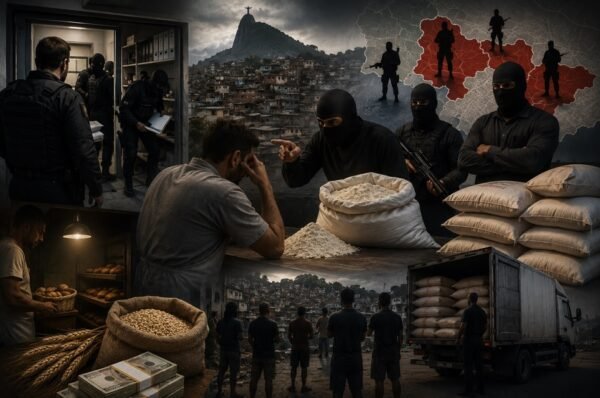
On Wednesday (03/06), the Civil Police launched an operation targeting a criminal group accused of extorting merchants, particularly in the Baixada Fluminense region and Rio de Janeiro’s West Zone, in order to force them to purchase food products — including wheat flour — from suppliers linked to militia groups and criminal factions. Officers from the Organized Crime Repression and Special Investigations Division (Draco/IE) executed search and seizure warrants at several addresses in the West and North zones of the capital. The investigation focuses on a scheme that allegedly combined economic coercion, territorial control, and commercial monopolization to generate illicit profits for criminal organizations.
This Content Is Only For Subscribers
To unlock this content, subscribe to INTERLIRA Reports.
Threats
Investigators found that the group routinely used threats of retaliation, financial losses, and even the forced closure of businesses to pressure merchants into complying with its demands. According to the investigation, victims were compelled to purchase products in quantities exceeding their operational needs and at prices significantly higher than market rates. The scheme primarily targeted small and medium-sized businesses, many of which became economically dependent on the organization in order to continue operating. Authorities believe the intimidation campaign created an environment in which merchants had little choice but to accept the imposed conditions.
Business Structure
According to investigators, the group developed a sophisticated business structure designed to give a veneer of legitimacy to its criminal activities. The network allegedly facilitated the distribution of goods and handled the financial transactions generated by the scheme. Police identified evidence suggesting that the economic exploitation of local businesses forms part of a broader strategy of territorial control, through which organizations linked to militias and drug trafficking expand their influence over legitimate commercial sectors. Authorities believe this model allows criminal groups to diversify their sources of revenue while strengthening their control over communities and local markets.
Flour Mafia
The investigation is connected to complaints made earlier this year regarding the “Flour Mafia.” In March, the Belford Roxo municipal government reported that traffickers linked to a criminal faction were forcing bakery owners in parts of the city to purchase wheat flour exclusively from suppliers associated with the group. According to the allegations, the product was being sold at nearly twice the normal market price. The practice reportedly affected businesses in the São José and Parque Suécia neighborhoods, located near the border with the municipality of Duque de Caxias. As a result, the price of a bread roll allegedly increased from R$0.50 to R$0.80 in some establishments. The 54th Police Precinct opened an investigation into the case. One report indicated that merchants were being forced to buy 25-kilogram bags of flour for R$100, while the same product typically sold for between R$60 and R$70 through legitimate suppliers.
Investigation
The main objective of Wednesday’s operation is to seize documents, accounting records, electronic devices, and other evidence that may help authorities further map the organization’s structure and financial activities. Investigators are also seeking to identify all individuals involved in the scheme, trace the flow of money generated by the operation, and determine whether the group is connected to other criminal offenses. According to the Civil Police, the investigation remains ongoing and may lead to additional operations as new evidence emerges.
Analysis:
The operation against the “Flour Mafia” illustrates a broader transformation in the business model of organized crime in Rio de Janeiro. Rather than relying exclusively on drug trafficking or extortion, criminal groups are increasingly seeking to control legitimate economic activities within the territories they dominate. By forcing merchants to purchase products from suppliers connected to militias or trafficking organizations, these groups create captive markets that generate stable revenue streams while reinforcing their local authority. This type of economic coercion allows criminal organizations to profit from everyday commercial transactions without necessarily resorting to visible violence, making their influence more difficult to detect and dismantle.

