


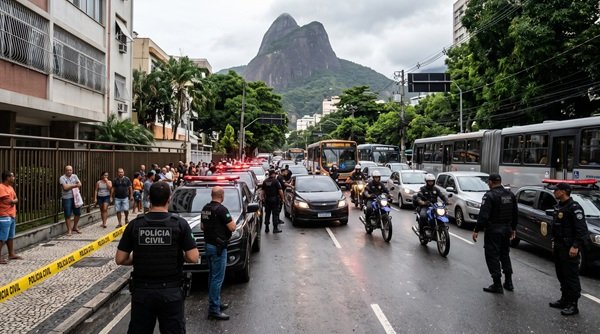
The Civil Police of Rio de Janeiro has identified a criminal organization linked to the Red Command (Comando Vermelho – CV) specializing in robberies and thefts in the South Zone, whose members selected victims based on their purchasing power. The investigations gained prominence after archaeologist Tania Andrade Lima was shot three times during a robbery in Leblon on October 15, 2026. According to authorities, approximately 11 people were part of the gang, which operated with an organized structure to select victims, monitor police presence, and execute the crimes. On October 21, one of the alleged leaders of the group, 28-year-old Luiz Fernando Rodrigues dos Santos, died during a clash with civil police officers in Botafogo. His location was tracked with the help of the Civitas Rio system, which monitored the vehicle used by the group for approximately 1 hour and 22 minutes. The episodes highlight the operations of criminal organizations in higher-income areas and the use of technology in police investigations.
This Content Is Only For Subscribers
To unlock this content, subscribe to INTERLIRA Reports.
Criminal organization uses specialized structures to commit robberies in the South Zone
According to Police Chief Alexandre Netto, head of the 14th Police Station (Leblon), the South Zone is one of the main operational areas for the gang linked to the CV, owing to the purchasing power of those in the area. Investigations identified approximately 11 individuals with specific roles in preparing and executing the crimes. The structure included members responsible for selecting vulnerable victims, identifying targets, and monitoring escape routes and police presence. The criminals primarily used motorcycles to facilitate quick escapes following the robberies. According to the Civil Police, CV members provided support to the organization, indicating that the robberies were part of a coordinated criminal structure. Investigations are ongoing to identify the remaining participants.
Suspected gang leader dies during police operation in Botafogo
On October 21, Luiz Fernando Rodrigues dos Santos, identified as one of the gang’s leaders, died during a police operation on São Clemente Street in Botafogo, near Morro Santa Marta. The suspect had 27 police records, mostly for robbery, and was under investigation for his potential involvement in the attempted robbery-homicide (latrocínio) of archaeologist Tania Andrade Lima, who was shot three times on General Venâncio Flores Street in Leblon on October 15. According to the Civil Police, during the attempted interception, Luiz Fernando drove his vehicle toward officers and fired a shot, prompting a response from the agents. He was hit and transported to the Miguel Couto Municipal Hospital, where he died from his injuries. A woman inside the automobile sustained injuries caused by shrapnel, while another vehicle was struck during the pursuit. The incident caused traffic road closures and delays, and the circumstances surrounding the clash are under investigation by the Capital Homicide Division.
Electronic surveillance aids in locating the suspect
The operation in Botafogo was supported by the Intelligence, Surveillance, and Technology Center in Support of Public Safety (Central de Inteligência, Vigilância e Tecnologia em Apoio à Segurança Pública – Civitas Rio), a monitoring system operated by the Rio de Janeiro City Hall. At the request of the 14th Police Station, the vehicle used by Luiz Fernando was tracked for approximately 1 hour and 22 minutes between 9h16 and 10h38 on October 21, passing through six neighborhoods: Centro, Lapa, Catete, Glória, Flamengo, and Botafogo. During this route, the system issued 19 alerts identifying the automobile, enabling police teams to monitor its movement up to the interception on São Clemente Street. According to authorities, the vehicle provided logistical support to the gang. The episode demonstrates the importance of integrating monitoring technology with police intelligence when tracking suspects involved in property crimes.
Analysis
The investigations indicate that criminal organizations employ specialized structures to carry out property crimes in Rio de Janeiro’s higher-income neighborhoods. The attack on the archaeologist in Leblon highlights the risks of violent encounters in public spaces, particularly following cash withdrawals or visits to financial establishments.
From a corporate security perspective, these episodes emphasize the importance of employee guidance, transit route planning, and preventive measures. The clash on a busy Botafogo street highlights the indirect risks that police operations pose to pedestrians and drivers. In this context, continuous monitoring of security conditions and emergency preparedness remain essential to mitigating risk exposure.

