


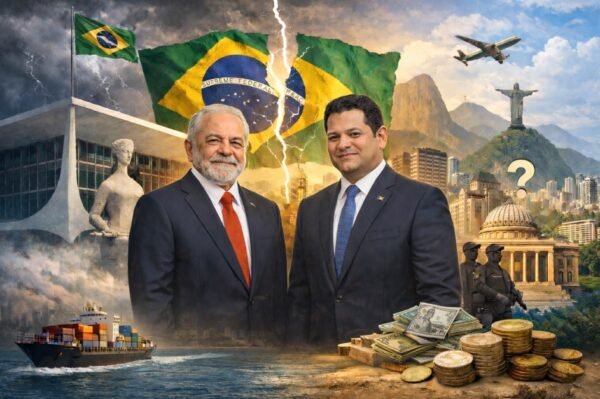
Brazil’s political landscape this week was marked by growing institutional tension, corruption investigations, and the early consolidation of the 2026 presidential race. New Datafolha polls showed President Lula (PT) and Senator Flávio Bolsonaro (PL) tied in a second-round simulation, while most Brazilians described the relationship between the federal government and Congress as more confrontational than cooperative. The political climate worsened after revelations involving Flávio Bolsonaro and businessman Daniel Vorcaro, former owner of Banco Master, in discussions about financing a film centered on Jair Bolsonaro. At the same time, the Lula administration continued to face resistance in the Senate following the rejection of Jorge Messias’s nomination to the Supreme Federal Court (STF), increasing uncertainty around the progress of key government proposals. In Rio de Janeiro, former governor Cláudio Castro became the target of a Federal Police operation investigating alleged tax fraud and money laundering involving the Refit Group and suspected links between public officials and organized crime. Meanwhile, Congress advanced debates over reducing the workweek and ending the 6×1 shift model, while the proposed Public Security Constitutional Amendment (PEC) remained stalled amid disputes between the Presidential Palace and Senate leadership.
This Content Is Only For Subscribers
To unlock this content, subscribe to INTERLIRA Reports.
New Poll
President Lula (PT), seeking re-election, and Senator Flávio Bolsonaro (PL) appear tied in a second-round simulation released by Datafolha on Saturday (16/05). Both candidates registered 45% of voting intentions, while 9% of respondents opted for blank or null votes and 1% said they were undecided. The poll has a margin of error of two percentage points. Interviews were conducted on May 12 and 13, before the publication of the conversations involving Flávio Bolsonaro and Banco Master owner Daniel Vorcaro. The recordings revealed that the senator made financial requests to the businessman, who is under investigation in a scheme involving bribery and fraud in the financial sector, after an agreement linked to R$ 134 million to produce a film about Jair Bolsonaro. At the same time, the survey reflects public reactions to several major political developments, including the Senate’s rejection of Jorge Messias’s nomination to the Supreme Federal Court (STF), the launch of “Desenrola 2.0,” a new debt renegotiation program, and Lula’s meeting with U.S. President Donald Trump at the White House. Compared to the previous Datafolha survey, released on April 11, the electoral scenario remained stable.
Relationship with Congress
The relationship between President Lula’s (PT) government and the National Congress is viewed by 70% of Brazilians as more confrontational than cooperative, according to a new Datafolha survey. Another 20% of respondents perceive more collaboration than conflict, while 2% said they see neither cooperation nor confrontation, and 8% did not know how to answer. The poll interviewed 2,004 people in 139 municipalities across the country and has a margin of error of two percentage points. Most interviews were conducted before the release of conversations in which Senator Flávio Bolsonaro allegedly asked Daniel Vorcaro for financial support. This year, beyond rejecting Jorge Messias’s nomination to the STF, the Senate also overturned Lula’s veto on reducing sentences for individuals convicted in relation to coup-related acts linked to January 8. The survey reflects the broader perception of institutional tension between the Executive and Legislative branches amid growing political polarization and disputes over the government’s agenda.
Banco Master Case
Senator Flávio Bolsonaro (PL), currently considered his party’s pre-candidate for the Presidency of the Republic, requested financial support from Daniel Vorcaro, former owner of Banco Master, to fund a film about former president Jair Bolsonaro. According to the investigation, Vorcaro paid R$ 61 million to produce “Dark Horse,” a movie centered on Bolsonaro’s political trajectory. Audio recordings from September 2025 reportedly capture Flávio requesting additional funds from the businessman. In a statement, the senator confirmed that he sought financial backing for the production but denied receiving any improper advantages or offering favors in return. Flávio had previously attempted to distance himself from the Banco Master scandal. After his ally Ciro Nogueira (PP-PI) became the target of a Federal Police operation, the senator publicly claimed that “they want to link me to Ciro Nogueira, but Banco Master belongs to Lula.” The disclosure of the conversations with Vorcaro caused concern among Bolsonaro allies. Presidential pre-candidate Romeu Zema (Novo), once considered as a possible running mate for Flávio, described the relationship as “unforgivable” and “a slap in the face.”
Former Governor of Rio
Former Rio de Janeiro governor Cláudio Castro (PL) became the target of Operation Sem Refino on Friday (15/05), an investigation led by the Federal Police (PF) into alleged tax fraud involving Refit, formerly known as the Manguinhos Refinery. The company is considered one of the country’s largest tax debtors. Businessman Ricardo Magro, owner of the Refit Group, is the subject of an arrest warrant, and the Federal Police requested the inclusion of his name on Interpol’s Red Notice list of internationally wanted fugitives. According to investigators, the operation examines suspicions that Refit used its corporate and financial structure to conceal assets, launder money, and move resources abroad. The PF also alleges that Castro acted decisively to protect and favor the interests of the Refit Group during his administration. Federal agents executed search warrants at the former governor’s residence in a condominium in Barra da Tijuca, in Rio’s Southwest Zone. Castro was present during the operation and accompanied the searches alongside his lawyers. The warrants were authorized by Supreme Federal Court (STF) Justice Alexandre de Moraes within the scope of investigations connected to the ADPF das Favelas, which examines links between criminal organizations and public officials in Rio de Janeiro.
6×1 Shift
The president of the Chamber of Deputies, Hugo Motta (Republicanos), reached an agreement to move forward with voting on the government’s proposal to end the 6×1 work shift model, one of President Lula’s main labor initiatives ahead of the elections. The proposal is expected to be analyzed alongside the Proposed Constitutional Amendment (PEC) already under discussion in Congress. Government representatives and lawmakers also reached a consensus around reducing the standard weekly workload from 44 hours to 40 hours without salary reductions, although transition rules and implementation details remain under debate. The agreement was reached on Wednesday (13) during a meeting involving Motta, Institutional Relations Minister José Guimarães, Planning Minister Bruno Moretti, Labor Minister Luiz Marinho, and members of the Chamber commission responsible for discussing the proposal. Until recently, Motta had resisted advancing the bill, which the government submitted under urgent procedures without prior consultation with the Speaker. He had favored the PEC route, which involves a slower legislative process and broader negotiations under the rapporteurship of one of his allies.
Security PEC
Amid tensions between the Presidential Palace and Senate President Davi Alcolumbre (União Brasil), the proposed Constitutional Amendment related to Public Security is now expected to be voted on only after the elections. This assessment is shared by both government officials and members of the opposition. Opposition senators have shown little urgency in advancing the debate, and since the proposal arrived in the Senate, Alcolumbre has repeatedly postponed putting it on the agenda. The text has already been approved by the Chamber of Deputies and is not expected to undergo substantial modifications in the Senate. Following the Senate’s rejection of Jorge Messias’s nomination to the STF, senators privately acknowledged that the political atmosphere deteriorated further, making the discussion of sensitive topics less viable for the moment. Government officials also argue, privately, that delaying the vote gives President Lula more room to postpone the recreation of the Ministry of Public Security. Lula has been under pressure to reestablish the ministry but publicly conditioned the measure on the approval of the PEC in Congress.
Analysis:
Brazil is in an increasingly polarized and unstable pre-electoral environment in which institutional disputes, corruption investigations, and electoral positioning are becoming deeply interconnected. The tie between Lula and Flávio Bolsonaro in second-round polling reflects not only a divided electorate but also the consolidation of a political dispute centered on two highly mobilized camps. At the same time, the perception among most Brazilians that the relationship between the Executive and Congress is dominated by confrontation reinforces the image of institutional fragmentation.
The Banco Master case adds another layer of political vulnerability to an already tense scenario. The involvement of figures connected to both government and opposition sectors demonstrate how corruption investigations continue to shape Brazil’s political dynamics regardless of ideological alignment. For Flávio Bolsonaro, the revelations create reputational risks at a moment when his presidential viability is being tested in national polling. Simultaneously, the Federal Police operation targeting former governor Cláudio Castro reinforces how corruption investigations in Rio de Janeiro remain intertwined with broader concerns involving political patronage, business interests, and alleged links between public officials and criminal structures. These investigations contribute to a climate in which institutional credibility becomes increasingly fragile.
Sources: A Folha de SP [1], [2], [3], [4], [5], [6]; O Globo [1], [2], [3]; G1 [1], [2].

