


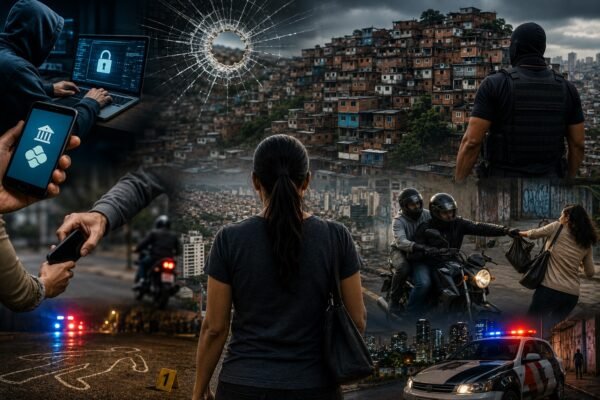
A Datafolha survey released on Sunday (10/05) revealed that 40% of Brazilians aged 16 or older were victims of some type of crime over the last 12 months. The poll, titled “The Triggers of Insecurity,” was commissioned by the Brazilian Forum on Public Security and conducted between March 9 and 10 with 2,004 respondents in 137 municipalities across the country. The margin of error for the overall data is two percentage points, plus or minus, with a confidence level of 95%, although the margin varies depending on the type of crime analyzed. The results portray a scenario in which violence, scams, and fear of organized crime increasingly shape the daily lives and behavior of the Brazilian population.
This Content Is Only For Subscribers
To unlock this content, subscribe to INTERLIRA Reports.
Digital Scams
Digital scams causing financial losses were identified as the most common crime affecting Brazilians, impacting 15.8% of respondents – the equivalent of approximately 26.3 million people nationwide. In this category, the margin of error is 1.6 percentage points, plus or minus. Respondents also reported having been victims of fraud or theft involving banking apps and digital payment systems such as Pix (12.4%). In addition, 9.7% said they had either been victims of or personally knew someone affected by stray bullets, while 8.3% reported having their cell phone stolen or robbed. The numbers reinforce the growing importance of cybercrime and financial fraud in Brazil’s broader public security landscape.
Murders
Regarding lethal violence, 13.1% of respondents stated that they knew a family member, friend, or acquaintance who had been murdered within the last 12 months. The figure reflects the continued social impact of homicides across the country, especially in urban areas heavily affected by organized crime, territorial disputes, and armed confrontations.
Robbery
According to the survey, 6.5% of Brazilians said they had personally been robbed on the streets during the previous 12 months. Another 6.2% reported that a family member or acquaintance had been killed during a robbery. The findings reinforce the persistence of violent property crimes in large urban centers, where robberies involving firearms, motorcycles, and organized gangs remain frequent.
Gender
The survey also identified differences in the types of crimes most frequently reported by men and women. Among men, the highest percentage (17.6%) referred to online or cellphone scams involving financial losses, followed by fraud and theft of funds from banking apps or Pix accounts (13.4%) and cases involving the murder of a relative or acquaintance (13.1%). Among women, scams and financial fraud also appeared as the most common category, affecting 14.1% of respondents. Cases involving the murder of someone close represented 13.1%, while fraud or embezzlement of funds accounted for 11.6%. The results indicate that financial crimes increasingly affect all demographic groups, while lethal violence remains broadly present in Brazilian society.
Organized Crime
Forty-one percent of Brazilians aged 16 or older said they notice the presence of organized crime in the neighborhoods where they live. According to population estimates from the Brazilian Institute of Geography and Statistics (IBGE), this percentage corresponds to approximately 68.7 million people. Among respondents who reported perceiving organized crime in their communities, 43% described its presence as “not very visible,” while 25% considered it “very visible,” and 21% classified it as simply “visible.” According to the survey, the influence of criminal factions increasingly affects local dynamics, daily routines, and the behavior of residents in many regions of the country.
Rules of Coexistence
Among respondents who recognized the presence of criminal organizations in their neighborhoods, 35% stated that these groups strongly influence local decisions and informal rules of coexistence. Another 26.5% assessed the impact as moderate, while 19% described it as low. According to the Brazilian Forum on Public Security, the findings suggest that approximately 42.2 million Brazilians live in environments where organized crime acts as a force capable of regulating daily life. The consequences are extensive: 81% of respondents living in these contexts said they fear being caught in armed confrontations, 75% reported avoiding certain places, and 71% expressed fear that relatives could become involved in drug trafficking. In addition, 64% said they fear retaliation if they report crimes to authorities.
Analysis:
The survey results reveal how insecurity in Brazil has become increasingly multidimensional, extending far beyond traditional street crime. Digital scams now occupy a central position in the country’s public security landscape, reflecting the rapid migration of criminal activity into financial and technological environments. The large number of victims affected by fraud involving banking applications, Pix transfers, and online scams demonstrates how organized criminal networks have adapted to the digitalization of daily life. This transformation creates a form of insecurity that is less geographically concentrated and potentially capable of affecting all social groups simultaneously, regardless of location or income level.
The perception of organized crime in neighborhoods across the country also demonstrates that criminal organizations increasingly function not only as illicit economic actors but as parallel structures capable of influencing routines, mobility, and informal social rules within many communities.

